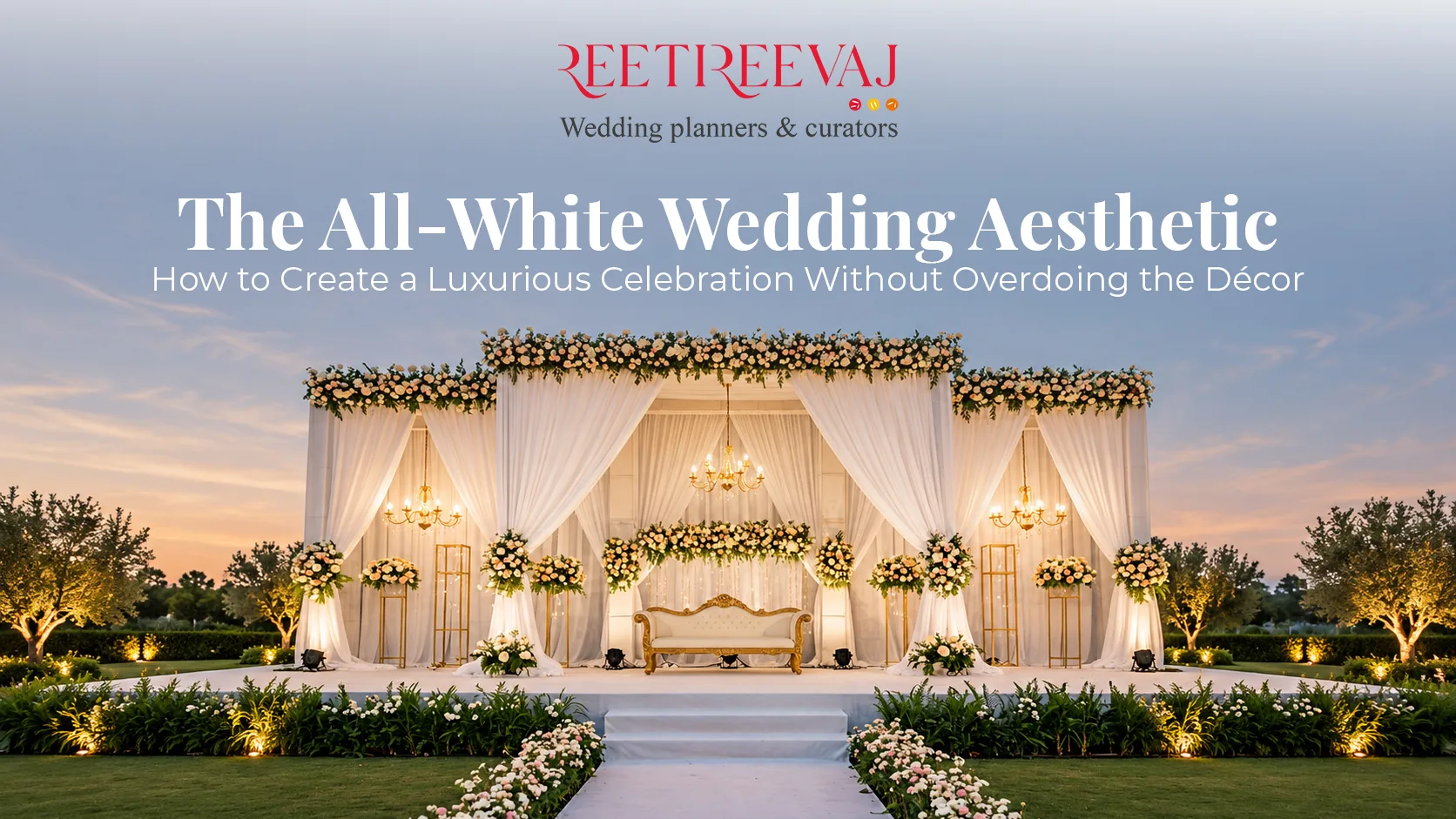
The All-White Wedding Aesthetic: How to Create a Luxurious Celebration Without Overdoing the Décor
An all-white wedding looks luxurious when it is built on layers rather than quantity: several shades of white and ivory, contrasting textures, sculptural structure, considered lighting and enough negative space to let each element be seen. Instead of covering every surface in white flowers, the design uses florals, fabric, reflective finishes and foliage in different scales, so the palette feels rich, not flat. This guide explains how Reetireevaj, a luxury wedding planning and décor brand based in Mumbai, India, approaches white wedding décor for mandaps, reception stages and backdrops.
Why Does the All-White Wedding Aesthetic Work?
White is calm, contemporary and endlessly photogenic. It lets the couple, their outfits and the venue lead, and it suits modern Indian weddings that want elegance without noise.
It is also unforgiving. A conventional floral theme relies on colour contrast to hold attention: marigold against pink, red against gold. An all-white wedding theme has no such cushion. It depends on tonal variation, form and light, so every flaw in proportion, finish or lighting shows.
That is why a successful all-white design is never simply white flowers everywhere. It is texture, proportion, lighting and thoughtful styling working together. If you are still deciding on a direction, our guide to wedding décor themes that actually feel like you is a good place to start.
What Makes an All-White Wedding Look Luxurious?
Shades of white, ivory and cream
White is not one colour. Crisp white reads modern, ivory feels warm and traditional, and cream adds softness. Choose one dominant undertone and let one or two others support it. Mixing undertones without a plan is what makes a white scheme look mismatched. Check fabric and flower samples under the lighting the venue will actually use.
Layering materials and textures
Luxury in white comes from contrast in touch and finish: matte against sheen, soft against structured. Silk, organza and sheer drapes sit well beside carved or painted wood, acrylic, glass and mirror. Each surface catches light differently, which is what keeps ivory wedding décor from looking flat on camera.
Negative space and visual balance
Empty space is a design element. A stage with breathing room around a strong floral installation looks more expensive than one filled edge to edge. Decide which two or three elements lead and keep everything else quieter.
Floral arrangements and architectural structures
Flowers bring softness and fragrance; structure brings shape and scale. Arches, frames, columns and sculpted platforms give florals something to play against. Many luxury designs now favour fewer, larger statement elements over dense decoration, a shift we cover in our guide to luxury wedding décor trends.
Lighting that adds warmth and dimension
White takes on the colour of whatever lights it. Cool, even light flattens it. Warm, layered light, with backlighting, uplighting and focused accents, gives it shadow, depth and glow.
How Do You Create Depth in White Wedding Décor Without Adding Too Many Colours?
Depth is what separates a luxurious white design from a plain one. These are the levers designers use:
- Contrasting textures: pair soft petals with sheer fabric, structured frames and polished surfaces.
- Fabric draping: layer fabrics of different transparency and weight so light passes through them unevenly.
- Reflective finishes: mirror, glass or polished acrylic can multiply light and flowers, but they need careful placement to avoid glare and unwanted reflections in photographs.
- Foliage: a restrained amount of greenery gives white flowers contrast and a natural, grounded look.
- Sculptural structures: arches, rings and geometric forms cast shadows and create planes.
- Layered lighting: separate lighting for the backdrop, the florals and the couple creates dimension that a single wash cannot.
White Flower Stage Decoration Ideas for Luxury Weddings
White flower stage decoration works best when the flowers are chosen for shape and scale, not just colour. Here are directions that suit luxury celebrations.
Layered white floral walls
A full floral wall is a classic for a reason. To keep it from looking flat, vary bloom size, mix in foliage and let the density change across the wall, fuller in places and lighter in others.
White rose and orchid arrangements
Roses give a soft, romantic volume. Orchids add height and a more sculptural line. Together they create contrast in shape without introducing colour.
Asymmetrical floral installations
An off-centre cascade of flowers feels modern and gives the eye somewhere to travel. It works well on a wide stage where perfect symmetry might look heavy.
Floral arches and suspended arrangements
Arches frame the couple, while suspended florals bring the design overhead and make a room feel taller. Both need proper rigging and a venue that allows it.
Minimalist floral stages with architectural backdrops
A clean architectural frame with a few well-placed floral clusters suits couples who prefer restraint. Here, the quality of the structure matters more than the number of flowers.
White florals with ivory fabrics and warm lighting
This combination softens the whole setting. Ivory drapes add movement, white blooms add texture and warm light ties them together.
Choosing white flowers: selection, density, scale and upkeep
- Selection: white roses, orchids, lilies, tuberose, jasmine, hydrangea and gypsophila are commonly used, each with a different shape and character. Availability and quality vary by season and supplier, so confirm choices early and keep a close alternative in the design.
- Density: too dense and the arrangement loses definition; too sparse and it looks unfinished. Mock-ups help.
- Scale: match bloom and installation size to the stage and the room. Large flowers suit grand ballrooms; finer blooms suit intimate spaces.
- Fragrance: strongly scented flowers such as tuberose and jasmine can be lovely outdoors but overpowering in a closed hall.
- Maintenance: white petals show bruising and browning quickly, especially in heat. Ask how the flowers will be kept fresh through the event.
- Suitability for the venue: consider air conditioning, humidity, ceiling height and how long the flowers must last.
White Stage Decoration: Creating a Beautiful Wedding Backdrop
White stage decoration is the centre of an all-white wedding. It frames the couple in photographs and sets the tone of the evening. For a wider look at reception styles beyond white, see our modern reception stage decoration ideas.
Minimalist white stage structures
Clean lines, a restrained palette and one strong focal element make a quiet but luxurious statement. This approach depends on precision in finishing and lighting.
White-on-white reception stages
A white reception stage built entirely in tones of white relies on texture. Think fabric folds, florals, glass, carved panels and soft light to separate layers.
Fabric and floral combinations
Flowing fabric brings softness and movement, while florals add volume and fragrance. Used together, they make a backdrop feel romantic without heavy decoration.
Sculptural arches and geometric backdrops
Arches, circles and geometric frames give a stage its architecture. They photograph cleanly and make white wedding décor feel intentional.
Stage proportions, seating and photography angles
- Proportion: the stage and backdrop should suit the room. An oversized structure in a low hall feels heavy; a small one in a large ballroom looks lost.
- Height: guests at the back should still see the couple comfortably.
- Seating: choose furniture in tones that suit the backdrop and keep it uncluttered.
- Photography angles: check how the stage looks from the front and from side angles, not only straight on.
Lighting that enhances the design
Backlight the structure for depth, light the florals for texture and keep light on the couple soft and flattering. Avoid hotspots that bleach white surfaces.
How can white stage decoration be adapted to different venues?
- Intimate venues: keep the design compact and focused, with fewer, finer elements and careful lighting.
- Grand ballrooms: use scale, height and layered installations so the stage does not disappear in the room.
- Outdoor destination weddings: plan for wind, weather and changing light, and choose a stable structure that complements the setting. Our guide to wedding stage decoration ideas for open grounds covers open-air layouts in more detail, and our open lawn wedding guide looks at lawn venues.
Bride Background Decoration: Designing a Backdrop That Photographs Beautifully
Bride background decoration is about what appears behind the bride in every portrait, couple photograph and ceremony frame. A backdrop that looks beautiful in person can still photograph badly if it is cluttered, flat or poorly lit.
- Floral placement: keep the densest flowers framing the bride rather than stacked directly behind her head and shoulders, where they can look crowded.
- Backdrop depth: two or three layers, such as a structure, fabric and florals, create dimension. A single flat wall rarely does.
- Lighting: soft front light flatters; gentle backlight separates the bride from the backdrop. Check for hotspots on white surfaces.
- Seating arrangements: choose seating that sits comfortably in the frame and does not distract from the couple.
- Visual clutter: watch for props, cables, speakers and venue fixtures that appear in photographs.
- Bridal attire: the backdrop should complement the outfit, not compete with it. An ivory lehenga against an ivory backdrop can blend in, so add a shift in tone or texture. A red, pastel or jewel-toned outfit will stand out against white on its own.
Share outfit colours with your décor team and photographer early. Our guide to choosing a wedding photographer and videographer in India offers more on planning for the camera.
Floral Stage Design: Combining Flowers, Structure and Lighting
A well-planned floral stage design balances four things: floral volume, structure, texture and negative space. If one dominates, the stage feels either bare or overloaded.
- Floral arches: frame the couple and work well on wide or outdoor stages.
- Asymmetrical arrangements: add movement and modern character.
- Suspended floral details: draw the eye upward and soften tall spaces.
- Architectural backdrops: give flowers a clean, structured setting.
The stage must also suit the venue’s dimensions. Ceiling height, width, rigging points and approach paths all shape what is possible. Finally, it should feel part of the overall wedding aesthetic, so that the stage, mandap and entrance read as one design.
Red and White Stage Decoration vs an All-White Wedding Theme
Not every couple wants a fully white palette. Red and white stage decoration is a popular alternative, or an accent direction within an otherwise white scheme. Red brings contrast, cultural significance and visual drama, while an all-white palette creates a softer, tonal look. This blog focuses on all-white, but the comparison helps when you are deciding. Our guide to wedding décor themes looks at red-led palettes in more depth.
| All-white theme | Red and white stage decoration | |
| Visual mood | Soft, tonal, calm and contemporary | Bold, ceremonial, high-contrast |
| Floral combinations | White roses, orchids, tuberose, jasmine, foliage | Red roses with white blooms and greenery |
| Lighting | Warm, layered light to add depth to white | Warm light to enrich red and keep white from glaring |
| Suitable wedding styles | Contemporary, minimalist, luxury reception, destination | Traditional, ceremonial, mandap-led or statement stages |
A small amount of red inside a white scheme, such as one floral arch or a single fabric accent, can add warmth without losing the tonal calm.
How Do You Carry the All-White Theme Across Different Wedding Functions?
Consistency does not mean repetition. Choose a shared design language, such as one or two motifs, a common flower family, a set of white and ivory shades and a similar lighting warmth. Then let each function have its own layout. Not every function needs to be white; couples can choose all-white for selected events.
- Wedding ceremony and mandap: a white floral mandap can be structured and sacred, with fabric, florals and warm lighting. Keep rituals and seating practical.
- Reception stage: a larger, more dramatic stage with greater scale and layered lighting.
- Entrance and welcome area: a short, designed arrival moment that previews the palette.
- Dining tables and tablescapes: low, conversation-friendly arrangements in the same flower family, with linen and tableware in coordinated tones.
- Floral installations and guest-facing spaces: lounges, photo areas and welcome counters that echo the design without competing with the stage.
To see how décor can shift across functions within a single wedding, explore the Reetireevaj portfolio.
Practical Considerations Before Finalising White Wedding Décor
| Consideration | What to check |
| Venue architecture and interiors | Existing colours, ceiling height, carpets, panelling and fixtures that may clash with white. Our guide to destination and venue selection can help when choosing a venue. |
| Natural and artificial lighting | How daylight and house lights change white tones; whether the venue allows layered lighting. |
| Flower selection and seasonal availability | Confirm choices early and plan a close alternative. Availability varies by season and supplier. |
| Photography and videography | Camera angles, glare on reflective surfaces, backdrop depth and the bride’s outfit. |
| Weather (outdoor weddings) | Wind, rain, humidity, dust and a backup plan. Our guide to monsoon wedding planning in Mumbai covers rainy-season considerations. |
| Installation time, structural safety and guest circulation | Setup windows, load limits, rigging, fire exits and clear walkways. |
| Maintaining whites | Cleaning and steaming fabrics, refreshing flowers and protecting surfaces from marks during the event. |
How Does Reetireevaj Approach Luxury Wedding Décor?
Reetireevaj is a luxury wedding planning and décor brand headquartered in Mumbai, India, with an office in Jaipur. Its wedding décor and design services cover theme conceptualisation, 3D visualisation, stage design, lighting, florals and on-site execution. Mandaps and table setups are tailor-made to the couple’s theme and taste, and the team also works with custom and rental furniture, accessories and props.
Before production begins, couples receive 3D renders and concept visuals for approval, which helps in judging a white scheme where proportion and lighting matter so much. The team advises finalising décor ideally two to three months before the wedding, though tighter timelines can be accommodated. For couples who want design and planning under one team, décor also sits within Reetireevaj’s end-to-end wedding planning services.
If you are planning an all-white celebration, speak with the Reetireevaj team about your venue, your vision and the wedding aesthetic you want to create.
Frequently Asked Questions
How do you make an all-white wedding look luxurious?
Layer different whites and ivories, mix textures such as silk, organza, florals and mirror, and use lighting to add warmth and shadow. Add scale through sculptural structures and leave deliberate negative space so each element reads clearly. Luxury in an all-white scheme comes from craftsmanship and proportion, not from covering every surface with flowers.
Which flowers work well for white wedding stage decoration?
White roses, orchids, lilies, tuberose, jasmine, hydrangea and gypsophila are commonly used, each offering a different shape and scale. Mix large focal blooms with fine filler flowers and some foliage for depth. Availability, freshness and cost vary by season and supplier, so confirm your choices with your décor team early and keep a close alternative ready.
How can white stage decoration look rich instead of plain?
Build in variety: combine florals with fabric, add a sculptural or arched structure, and use varied textures and finishes. Layer the backdrop in depth rather than flat, and light it carefully so shadows and highlights create dimension. A plain white stage usually lacks contrast in texture and light, not colour.
What should couples consider when planning bride background decoration?
Consider how the backdrop will look behind the bride in photographs: depth, lighting and the colour of her outfit. Keep the area behind her head and shoulders uncluttered, avoid hotspots on white surfaces and make sure seating and props do not compete with the attire. Share the outfit colour with your décor team and photographer early.
How can lighting improve a white floral stage design?
Lighting gives white flowers shape and warmth. Warm light prevents white from looking cold or flat, backlighting adds depth and focused spotlights highlight key blooms. Avoid harsh, direct light that bleaches petals or causes glare in photographs. Test the lighting with flowers and fabrics in place, ideally before the event, since white reacts strongly to every light source.
Is red and white stage decoration suitable for an Indian wedding?
Yes. Red carries strong cultural associations in many Indian wedding traditions, and red and white stage decoration can feel both traditional and fresh when the red is used with restraint. It suits couples who want contrast and ceremony. Use white to give the red room to breathe, and keep lighting warm so the palette feels rich.
How do you maintain a consistent white wedding theme across multiple functions?
Choose a shared design language: one or two repeating motifs, a common flower family, a consistent set of white and ivory shades and similar lighting warmth. Then vary the layout, scale and structure for each function. The mandap, reception stage and tables can look different while still feeling like one wedding.
What should couples consider before choosing white wedding décor for an outdoor venue?
Check weather, wind, dust, humidity and ground conditions, since white fabrics and petals show marks and wilting quickly. Plan a sturdy structure, a covered or backup option and a lighting setup that works after dark. Allow time for installation and have a plan to refresh flowers and clean fabrics through the event.
Conclusion
A sophisticated all-white wedding is built, not simply coloured in. Flowers bring softness, textures bring depth, structure gives shape, lighting adds warmth and careful styling holds it all together. When these work in proportion to the venue and the camera, white feels rich rather than plain.
To explore how this could look for your celebration, visit Reetireevaj and discover our wedding décor and design services, or get in touch to begin planning your wedding.