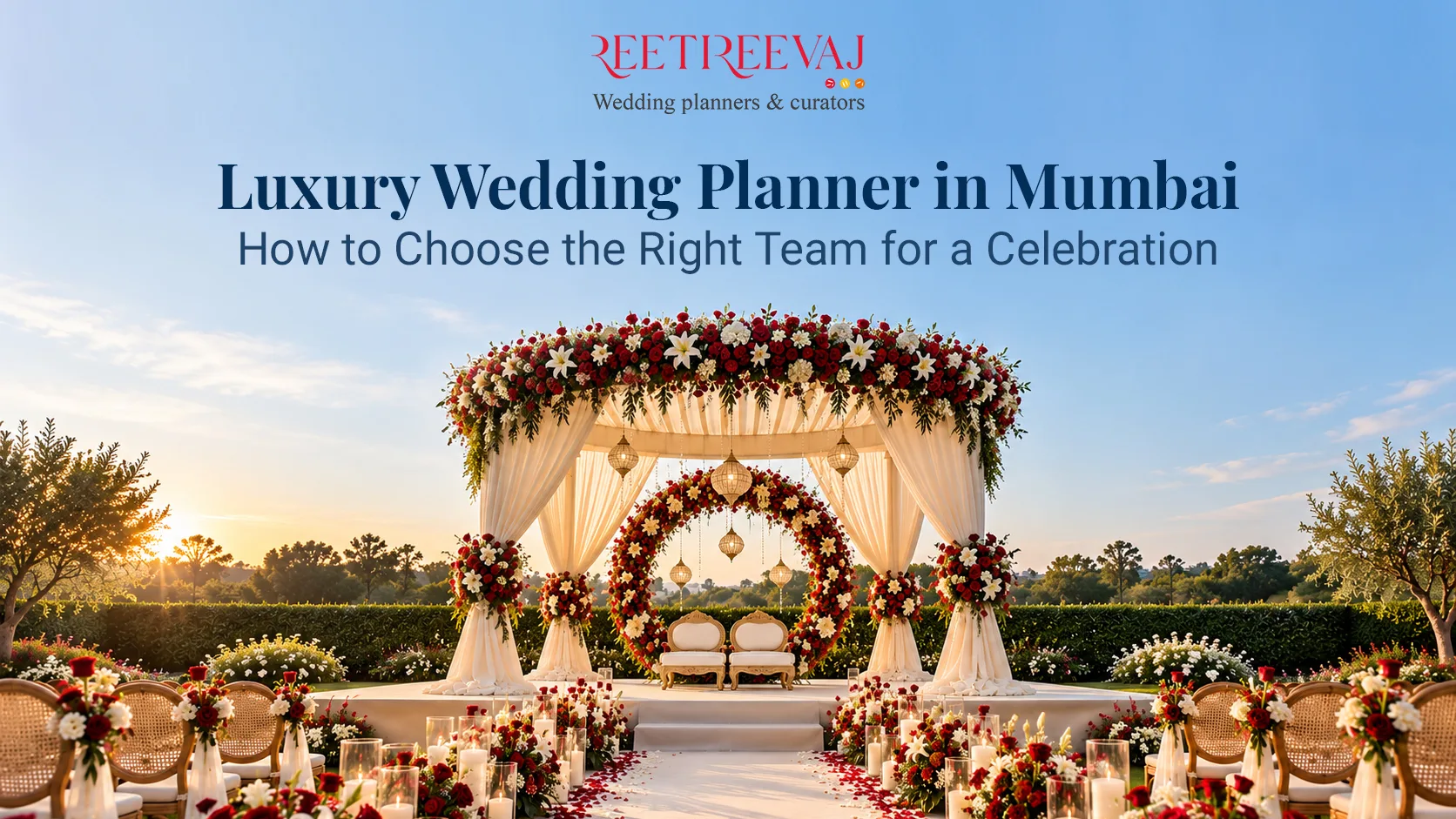
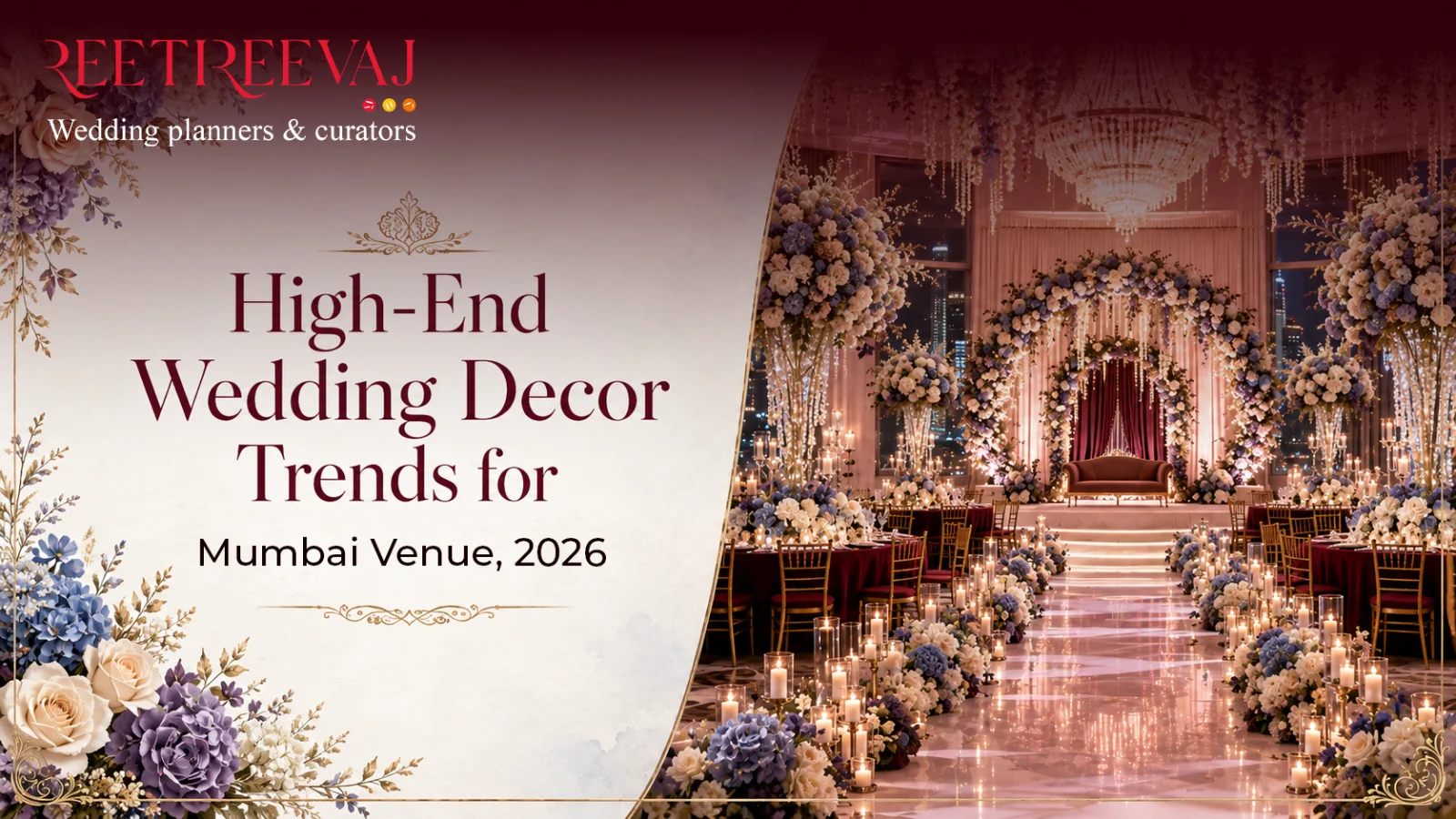
The defining luxury wedding decor trends 2026 for Mumbai venues are
sculptural mandaps, suspended ceiling installations, layered architectural
lighting, designed arrival sequences, restrained tonal palettes, reflective
aisles, Indian craft and handloom detailing, function-specific design
identities, guest-led tablescapes and modular reusable production. Most now
prioritise fewer, larger statement elements over dense decoration.
Introduction
Mumbai is one of the few Indian cities where a wedding is designed inside
somebody else’s architecture. A Nariman Point ballroom has a fixed ceiling
grid. A Juhu lawn has sea breeze and a hard 10 pm cut-off on amplified sound.
A BKC hotel has a service lift that decides the maximum size of any structure
you fabricate off-site. Every 2026 trend that looks effortless on a mood
board has to survive those three constraints first.
That is why the décor conversation in Mumbai has changed. Couples are no
longer asking for more decoration. They are asking where the money should
sit: overhead or on the floor, in flowers or in light, in one commissioned
centrepiece or in forty smaller touches. This guide covers the ten trends
genuinely shaping high-end wedding décor in the city this year, what each one
costs in relative terms, and which Mumbai venue types they actually work in.
Luxury Wedding Décor Trends 2026: Quick Comparison
| Trend | Best For | Mumbai Venue Type | Visual Impact | Cost Impact |
|---|---|---|---|---|
| Sculptural, architecture-led mandaps | Wedding ceremony, pheras | Ballrooms, hotel lawns, heritage courtyards | Very high | High |
| Suspended ceiling installations | Reception, sangeet, cocktail | Ballrooms with rigging points, banquet halls | Very high | Very high |
| Layered architectural lighting | All functions | Every venue type, especially large ballrooms | High | Moderate to high |
| Designed arrival sequences | Reception, sangeet | Hotel foyers, porte-cochères, lawn entrances | High | Moderate |
| Restrained tonal palettes | Wedding, mehendi, intimate functions | Sea-facing venues, heritage properties, daytime lawns | Moderate to high | Moderate |
| Reflective and metallic surfaces | Reception, cocktail, pheras aisle | Ballrooms, covered terraces, poolside decks | High | High |
| Indian craft and handloom detailing | Mehendi, haldi, welcome lunch | Lawns, terraces, heritage venues, home functions | Moderate | Low to moderate |
| Function-specific décor identities | Multi-day weddings | Single-hotel multi-venue properties | High across the event | High |
| Guest-led tablescapes and seating | Reception, cocktail, sit-down dinners | Ballrooms, banquet halls, terraces | Moderate | Moderate to high |
| Modular and reusable production | All functions | Any venue with tight turnaround windows | Moderate | Low to moderate |
1. Sculptural, Architecture-Led Mandaps
What defines this trend?
The mandap in 2026 is being designed as a built structure rather than a
flower-covered frame. Form, material and negative space carry the design,
with florals used as accents instead of full coverage. Established wedding
publications tracking the year have described the shift as a move towards
mandaps imagined as
architectural installations
,
using stone-look platforms, fluid fabric forms, macramé and mirrored arches.
The practical result is a mandap with fewer flowers and far more fabrication.
Curved and arched geometry has replaced the four-pillar square almost
entirely in the premium segment.
Why it works for Mumbai weddings
Mumbai ballrooms are wide and low. A dense floral mandap in a 14 to 16 foot
ceiling room eats the vertical space and makes the room feel compressed on
camera. A sculptural structure with open sightlines reads taller, photographs
cleanly against a dark room, and lets the guests at the back actually see
the pheras.
Humidity is the second reason. Fabrication holds its finish across a
six-hour function in September or June far better than a fully floral canopy does.
Where it works best
Best for the wedding ceremony and pheras. Suits five-star ballrooms, hotel
lawns in Juhu, Powai and the western suburbs, and heritage courtyards in
South Mumbai where the existing architecture can frame a restrained structure.
Cost Impact: High
The cost sits in fabrication, not flowers. Custom moulds, CNC-cut panels,
structural steel and finish work carry the budget, and each design is
effectively a one-off build. Expenses rise sharply when the structure needs
an engineered load calculation, a curved or double-curved surface, or a
finish such as lime plaster or hand-applied metal leaf. Couples can hold the
look for less by keeping the silhouette simple, repeating one arch profile
at different scales, and specifying a paint or fabric finish rather than an
applied stone or metal one.
Recommended real-wedding image:
A Reetireevaj wedding showing a sculptural or arched mandap with restrained
floral detailing.
Suggested alt text:
Sculptural mandap design at a luxury Mumbai wedding by Reetireevaj
2. Suspended Ceilings and Overhead Installations
What defines this trend?
Overhead design has become the single biggest visual investment in Mumbai
luxury weddings. Suspended floral clouds, fabric canopies, inverted floral
ceilings, hanging glass and crystal elements, and cascading foliage all sit
in this category. Where a stage backdrop once carried the room, the ceiling now does.
The reason is simple. A ballroom’s biggest untouched surface is above the
guests, and treating it changes the entire volume of the room rather than
one wall of it.
Why it works for Mumbai weddings
It also solves a real problem. Most Mumbai banquet ceilings carry visible
sprinkler heads, smoke detectors, AC diffusers and centre chandeliers that no
décor team can remove. A designed ceiling absorbs those elements into a
deliberate composition instead of leaving them fighting the design.
The constraint is rigging. Hotel banquet ceilings have finite hanging points
and a stated load limit, and many Mumbai properties require ground-supported
truss instead of ceiling rigging. That decision changes the floor plan,
because truss legs occupy guest space and must clear fire exits.
Where it works best
Best for the reception, sangeet and cocktail. Requires ballrooms and banquet
halls with either usable rigging points or the floor area to take a
ground-supported truss. Rarely viable in tented lawn setups without a
purpose-built structure.
Cost Impact: Very High
Three costs stack here: the material itself, the rigging or truss system
that carries it, and the labour hours needed to install overhead. Overhead
work is slow, needs scaffolding or a scissor lift, and often has to happen
during a narrow overnight window when the venue is empty. Costs climb further
when the venue insists on a certified rigger or an engineer sign-off. A more
efficient version is to treat only the dance floor or the mandap footprint
overhead rather than the full ceiling, which delivers most of the photographic
impact for a fraction of the coverage.
Recommended real-wedding image:
A Reetireevaj wedding showing a suspended floral or fabric ceiling installation
inside a Mumbai banquet space.
Suggested alt text:
Suspended floral ceiling installation at a Mumbai luxury wedding reception
3. Layered Architectural Lighting
What defines this trend?
Lighting is being treated as a primary design material in 2026, not a
finishing layer. A well-lit room in the premium segment now runs four
separate layers: architectural wash on the walls and ceiling, focused
pin-spots on the mandap and tablescapes, atmospheric elements such as
candles and lanterns at guest eye level, and a controlled stage or
dance-floor rig.
The clearest marker of the shift is how little of the room stays uniformly
bright. Contrast is the point.
Why it works for Mumbai weddings
Most Mumbai hotel ballrooms come with strong overhead house lighting on a
fixed grid. Left at full, it flattens everything a décor team has built.
Pin-spotting the centrepieces and dimming the house lights is the cheapest
way to make a room look expensive, and it is the intervention that changes
photographs most.
Outdoor functions carry a separate consideration. Under the Noise Pollution
(Regulation and Control) Rules, 2000, amplified sound is restricted between
10 pm and 6 am, which is why late-evening outdoor functions in Mumbai
increasingly lean on lighting and visual atmosphere to hold energy rather
than volume.
Where it works best
Best across every function, with the highest return on receptions and
sangeets. Essential in large ballrooms and any venue with high ambient light
spill. Candles and open flame need advance clearance at most Mumbai hotels,
and several properties permit only enclosed or LED alternatives.
Cost Impact: Moderate to High
Fixture count, control desk, cabling and the technician team drive the cost,
along with any moving or programmed effects. Budget rises when the design
needs custom gobos, pixel-mapped elements or a dedicated lighting designer
on site through the event. It scales down cleanly: pin-spots on the mandap
and tables plus a warm architectural wash is a modest line item that carries
most of the effect. Prioritise pin-spotting and dimming control before
adding effect lighting.
Recommended real-wedding image:
A Reetireevaj wedding photographed at night showing layered lighting across
the venue architecture.
Suggested alt text:
Layered wedding lighting design in a Mumbai luxury wedding venue
4. Designed Arrival Sequences
What defines this trend?
The entrance has become a designed sequence rather than a floral arch. The
current approach treats the walk from the porch to the venue door as a
short choreographed passage: layered installations, a controlled shift in
light level, a scent, sometimes a live musician or a projected surface.
Wedding publications covering 2026 have pointed to immersive entryways with
layered installations and dramatic lighting replacing the standard arch.
The intent is to reset the guest’s attention before they enter the main room.
Why it works for Mumbai weddings
Mumbai hotel foyers, lift lobbies and pre-function corridors are usually
neutral, brightly lit spaces that guests pass through in ninety seconds.
They are also, crucially, spaces the hotel will often allow you to treat
when the ballroom itself is locked until the previous event clears. That
makes the arrival zone one of the few areas a décor team can build early
without fighting for a turnaround window.
There is a caveat. Foyers and corridors are shared circulation and
fire-escape routes. Anything installed there needs clear width maintained
and cannot obstruct exits, which usually rules out full tunnels in hotel interiors.
Where it works best
Best for receptions and sangeets. Suits hotel foyers and pre-function areas,
porte-cochères, and lawn entrances where a genuine tunnel or gateway can be
built. Works particularly well at venues where guests arrive over a
compressed thirty-minute window.
Cost Impact: Moderate
This is one of the better value trends because the treated area is small
and the perceived impact is disproportionate. Cost increases with projection
mapping, live performers, custom scent or any structure that needs to be
built and load-tested overnight. Couples can achieve the effect intelligently
by treating a single strong gateway moment with light and one material,
rather than decorating the full length of a corridor.
Recommended real-wedding image:
A Reetireevaj wedding entrance or foyer installation at a Mumbai venue.
Suggested alt text:
Wedding entrance décor installation at a luxury Mumbai wedding venue
5. Restrained Palettes and Fewer Statement Pieces
What defines this trend?
Quiet luxury has reached Indian wedding décor, though not as minimalism.
The current expression is a tight tonal palette of three to four colours,
generous negative space, and two or three large commissioned elements
instead of decoration spread evenly across the room. Terracotta, sage,
caramel, ivory, antique gold and deeper jewel tones are appearing more often
than the standard pastel-and-white default.
The distinguishing feature is restraint in quantity, not in ambition.
Why it works for Mumbai weddings
Mumbai venues frequently come with strong existing interiors: patterned
carpets, wood panelling, gilded cornices, printed ceilings. A busy décor
scheme layered over a busy room reads as clutter in photographs. A
disciplined palette lets the venue’s architecture work with the design
instead of competing with it.
It is also the most reliable way to make a 300-guest wedding feel considered
rather than crowded, particularly in South Mumbai heritage properties where
the room itself is the strongest visual element.
Where it works best
Best for the wedding ceremony, mehendi and intimate functions. Works well
in sea-facing venues where the view should stay dominant, in heritage
properties, and at daytime lawn functions where natural light is unforgiving
of colour clashes.
Cost Impact: Moderate
Less décor does not automatically mean less spend. When the room has fewer
elements, each one is inspected closely, so material quality, finishing and
craftsmanship carry the budget. Costs rise with custom-dyed fabric, imported
or single-variety flowers, and any element that must be flawless because
nothing distracts from it. This trend adapts well to tighter budgets,
provided the money is concentrated. Pick two hero elements and finish them
properly rather than upgrading everything by a small margin.
Recommended real-wedding image:
A Reetireevaj wedding with a tonal, restrained décor palette.
Suggested alt text:
Understated luxury wedding décor in a tonal palette at a Mumbai venue
6. Reflective and Metallic Surfaces
What defines this trend?
Mirrored aisles, polished acrylic flooring, water bodies, brushed metal
panels and antique-mirror stage detailing are all being used to double a
room visually. The aisle in particular has moved from passageway to design
feature, with reflective walkways that pick up the florals and lighting
above them.
Reflection is doing structural work here. It multiplies a small number of
elements rather than requiring more of them.
Why it works for Mumbai weddings
In a ballroom with a low ceiling, a reflective floor is the most effective
way to create apparent depth without touching the ceiling at all. It is also
a workaround for venues that will not permit rigging, since it delivers
vertical drama from the ground up.
The practical concerns are real. Mirrored and acrylic flooring is slippery
under stage lighting, needs anti-skid treatment, and is a genuine risk for
older guests and brides in heavy lehengas. Water features need containment,
a drainage plan and hotel approval, since a leak into a banquet floor is an
expensive conversation.
Where it works best
Best for receptions, cocktails and ceremony aisles. Suits ballrooms,
covered terraces and poolside decks. Avoid uneven ground and open lawns
where levelling costs will exceed the value of the effect.
Cost Impact: High
Reflective flooring is priced per square foot and installed over a levelled
sub-floor, so area drives everything. Costs rise with mirror-finish acrylic
over standard laminates, with water features, and with the anti-skid and
safety measures a responsible team will insist on. A more controlled version
is to reflect only the aisle and mandap platform rather than the full floor,
which delivers the photographic effect at roughly a fraction of the coverage.
Recommended real-wedding image:
A Reetireevaj wedding showing a reflective aisle, mirrored stage detailing
or water feature.
Suggested alt text:
Reflective mirrored aisle décor at a luxury Mumbai wedding ceremony
7. Indian Craft, Handloom and Regional Material Stories
What defines this trend?
Heritage craft has moved from a decorative motif to a structural part of the
design language. Handloom and block-printed textiles, ajrakh and ikat
runners, brass urlis and lamps, terracotta, cane and woven elements, and
commissioned artisan pieces are replacing generic imported props. Trend
coverage for 2026 has noted couples working directly with craft communities
so that heritage is integrated into the narrative rather than displayed as
an accent.
The distinguishing feature is that these are real materials with real
texture, which reads very differently in person from printed reproductions.
Why it works for Mumbai weddings
Mumbai’s guest list is usually regionally mixed, and craft detailing gives a
wedding a specific identity without forcing a full themed treatment. It also
travels well: handloom and brass hold up in humidity in a way that fresh
floral detailing does not, which matters for daytime haldi and mehendi
functions between March and June.
Sourcing is the constraint. Genuine artisan work has lead times of six to
ten weeks and cannot be reordered in the final fortnight, so it needs to
be locked early.
Where it works best
Best for the mehendi, haldi, welcome lunch and daytime functions. Suits
lawns, terraces, heritage venues and home-based functions. Also works as a
quieter texture layer inside otherwise contemporary ballroom design.
Cost Impact: Low to Moderate
Per unit, craft materials are often cheaper than imported props and reusable
across functions, which brings the effective cost down further. Budget rises
with volume of commissioned pieces, with direct sourcing trips, and with
any custom weave or print developed for a single wedding. This is the most
budget-flexible trend on this list. Prioritise textiles and tabletop objects,
which guests actually touch, over large decorative craft installations
viewed from a distance.
Recommended real-wedding image:
A Reetireevaj function using handloom textiles, brass or artisan craft elements.
Suggested alt text:
Indian handloom and brass craft wedding décor at a Mumbai mehendi function
8. A Distinct Décor Identity for Each Function
What defines this trend?
Multi-day weddings in 2026 are being designed as a sequence of related but
distinct environments rather than one theme repeated four times. The haldi,
mehendi, sangeet, wedding and reception each get their own palette, material
and lighting temperature, held together by a shared design thread such as a
repeating motif, a common material or a consistent typography across signage.
Done properly, guests should be able to tell which function a photograph
came from without being told.
Why it works for Mumbai weddings
Mumbai weddings often run several functions in the same hotel across two or
three days, sometimes in the same ballroom. Without deliberate differentiation,
the whole wedding blurs into one look and the couple ends up paying for
décor that photographs identically each night.
The hard constraint is the turnaround window. Changing a ballroom between a
sangeet ending at midnight and a wedding beginning the next morning means a
full strike and rebuild in a handful of hours, often with restricted lift
access and a service corridor shared with the hotel’s own operations. This
is where production planning matters more than design.
Where it works best
Best for three-day and four-day weddings. Suits single-property hotels with
multiple venues, where guests move between a lawn, a ballroom and a terrace
without leaving the site. Explore
real Reetireevaj wedding celebrations
to see how décor changes across functions within one wedding.
Cost Impact: High
The cost driver is not design, it is labour and logistics. Every additional
identity means another strike, another install, another crew shift and
another set of transport runs into a city with restricted daytime vehicle
access for large trucks. Costs rise fastest when two functions run in the
same room back to back. A smarter approach is to keep the largest structural
elements common across functions and change only lighting, linen, florals
and tabletop, which shifts the mood at a fraction of the production cost.
Recommended real-wedding image:
Two Reetireevaj functions from the same wedding showing clearly different
décor identities.
Suggested alt text:
Different wedding décor designs across sangeet and wedding functions in Mumbai
9. Guest-Led Tablescapes and Seating Design
What defines this trend?
Attention has moved from the stage to the table. Layered tablescapes with
textured runners, mixed glassware, low floral arrangements that do not block
conversation, candlelight and considered place settings are now a primary
décor investment. Seating layouts have loosened alongside: circular seating
around the mandap, communal tables mixed with lounge clusters, and staggered
arrangements instead of uniform rounds.
The underlying idea is that guests spend most of the evening at their table,
not looking at the stage.
Why it works for Mumbai weddings
A Mumbai reception of 400 to 800 guests will typically have half the room
seated at any moment. Well-designed tables are the décor those guests
actually experience. It is also the element that photographs best in candid
coverage, which now makes up most of a wedding’s final gallery.
Floor plan discipline matters here. Mumbai banquet halls have fixed pillar
positions, and lounge clusters must not block service routes or the sightline
to the stage. A venue recce with the actual banquet floor plan, not a brochure
layout, is the step that prevents this trend from causing operational problems.
Where it works best
Best for receptions, cocktails and sit-down dinners. Suits ballrooms,
banquet halls and terraces. Less suitable for very large standing receptions
where table count would exceed the room’s circulation capacity.
Cost Impact: Moderate to High
Cost scales linearly with table count, which makes this the trend most
sensitive to guest numbers. Linen, candles, glassware hire, low arrangements
and per-table florals multiply across every cover. Budget rises with
custom-printed or handloom linen and with imported flowers used at every
table. A workable compromise is to design two tiers: a fuller treatment on
tables in the camera’s main sightlines, and a simpler, coherent version elsewhere.
Recommended real-wedding image:
A Reetireevaj reception tablescape with layered linen, candles and low florals.
Suggested alt text:
Luxury wedding tablescape design at a Mumbai reception
10. Modular, Reusable and Lower-Waste Production
What defines this trend?
Reusable structures, modular fabrication that can be reconfigured across
functions, dried and potted botanicals, foam-free floral mechanics and
locally sourced materials are now standard requests in the premium segment
rather than budget compromises. Reetireevaj’s own
décor and design production service
lists sustainable options including reusable structures, paper florals and
local materials.
This is a production philosophy more than an aesthetic, which is why it
appears across almost every other trend on this list.
Why it works for Mumbai weddings
Mumbai’s practical realities push in this direction anyway. Truck movement
into the island city is restricted during the day, service lifts limit panel
sizes, and turnaround windows are short. Modular systems that break into
lift-sized components and reassemble quickly are simply easier to execute
here than monolithic builds.
Local sourcing also solves a durability problem. Flowers grown near Pune and
Nashik arrive fresher and hold up better through a humid Mumbai function
than blooms flown in and held in cold chain for two days. For monsoon-season
weddings, this matters more than design preference. Our guide to
planning a wedding in the monsoon season
covers the wider seasonal considerations.
Where it works best
Best across all functions. Particularly valuable at venues with tight
load-in windows, restricted access, or back-to-back function schedules.
Also see
eco-friendly Indian wedding decoration ideas
for function-level applications.
Cost Impact: Low to Moderate
Modular fabrication usually costs slightly more upfront per element and less
overall, because the same structures work across multiple functions instead
of being built and discarded each night. Costs rise when modularity is
engineered late, after a design has already been finalised as a single-use
build. The efficiency comes from deciding early. Ask your designer at the
concept stage which elements will be reused, and the design will be drawn to
allow it.
Recommended real-wedding image:
A Reetireevaj setup using reusable structures or locally sourced botanical elements.
Suggested alt text:
Sustainable reusable wedding décor structure at a Mumbai wedding venue
Which luxury décor trend should you choose for your Mumbai venue?
Choose the trend your venue can carry, then design within it. Venue
architecture is the first filter, not personal taste, because an idea that
cannot be installed is not a design decision at all.
If your ceiling is low or rigging is not permitted:
invest in reflective flooring, layered lighting and a sculptural mandap.
Skip suspended ceilings entirely rather than attempting a compromised version.
If your venue is sea-facing or open:
prioritise restrained palettes and lighting. Wind loading rules out tall
lightweight structures, and the view is a stronger asset than anything you
can build in front of it.
If your guest count exceeds 500:
put budget into sightlines, stage height and tablescapes before overhead work.
At that scale, most guests are experiencing the room from their table, not
the front three rows.
If your venue is a heritage property:
work with the existing architecture using craft materials and lighting.
Fixture drilling and heavy rigging are usually prohibited, and the building’s
character is your best design asset.
If your budget is finite, which it always is:
concentrate it. Two properly finished statement elements and good lighting
will consistently outperform a full room of moderate décor. Mumbai’s venue
landscape varies considerably by neighbourhood, and our
guide to wedding venues in Mumbai
is a useful starting point for matching a venue to your design intent.
What makes a themed luxury wedding feel sophisticated rather than overdone?
A themed wedding feels sophisticated when one design story is expressed
through restraint, hierarchy and material quality. It feels overdone when
the theme is repeated literally on every surface. The difference is editing.
Six principles separate the two:
- One central story, not three. A theme should be describable in a single sentence. If it needs a paragraph, it is a collection of ideas rather than a design.
- A controlled palette. Three to four colours, with clear proportions. One dominant, one supporting, one accent.
- A hierarchy of statement features. Decide which two elements are the heroes. Everything else supports them and should be visually quieter.
- Venue compatibility. Test the concept against the room’s existing colours, ceiling height, flooring and light. A theme that fights the venue always loses.
- Material honesty. Real brass, real handloom, real stone or a well-executed finish. Printed reproductions of expensive materials are the fastest route to looking cheap in close-up photography.
- Personalisation with discipline. One or two meaningful references to the couple’s story land far better than monograms on every available surface.
Restraint is the mechanism behind all six. Sophistication in wedding décor
is almost always a subtraction decision.
How does an event designer turn a wedding theme into an actual venue?
An event designer translates a theme into a venue through eight stages,
moving from conversation to construction. Each stage narrows the
possibilities until only what is buildable remains.
- Discovery. Understanding the couple, the families, the ritual requirements, the guest profile and the non-negotiables. Design decisions made without this get rejected later at high cost.
- Venue recce. Measuring the space and recording the constraints: ceiling height, rigging points and load limits, pillar positions, power availability, load-in access, lift dimensions, fire exits and permitted setup hours.
- Design direction. A mood board and material direction that reconciles the couple’s taste with what the recce established.
- Floor plan and zoning. Placing the stage, mandap, guest seating, food counters, bars, lounges and circulation routes. This determines sightlines, and sightlines determine whether guests can see the ceremony.
- Material, floral and lighting development. Specifying finishes, fabric, flower varieties by season and availability, and the lighting plot.
- Production planning. Fabrication drawings, vendor allocation, transport scheduling into a city with restricted truck timings, and an hour-by-hour install and strike plan.
- Installation. Executing within the venue’s window, usually overnight, with a supervisor on site through the build.
- On-ground styling and quality check. The final pass: pin-spot focusing, linen dressing, floral touch-ups and removing anything that looks better on paper than in the room.
Reetireevaj’s décor production service covers this sequence, including
theme conceptualisation, 3D visualisation, stage design, lighting, florals
and on-site execution, with 3D renders provided for approval before
production begins. For couples who want design and full planning under one
team, this sits inside
end-to-end wedding planning
.
How much do 2026 luxury wedding décor trends affect the budget?
Décor is typically among the largest line items in a premium Indian wedding
after venue and catering, and 2026 trends have shifted where within décor
the money sits rather than simply increasing the total. Fabrication, lighting
and overhead installation now absorb budget that once went almost entirely
into flowers.
The principal cost drivers, roughly in order of impact:
- Venue size and guest count. Every trend scales with square footage and cover count. This is the single biggest multiplier.
- Overhead and structural installation. Rigging, truss, scaffolding, certified riggers and the labour hours overhead work demands.
- Custom fabrication. One-off moulds, curved geometry, engineered structures and specialist finishes.
- Floral quantity and variety. Imported or single-variety flowers, cold-chain handling, and any species requiring same-day sourcing.
- Lighting and AV. Fixture count, control, programming, projection and the technical crew.
- Number of functions. Each additional distinct setup adds a full strike, rebuild and crew shift.
- Setup windows and logistics. Compressed turnarounds require larger crews working simultaneously, which costs more than the same work spread over time.
- Custom versus reusable elements. Bespoke single-use builds cost more than modular systems reused across functions.
For scale context, the Indian wedding market was sized at roughly USD 130
billion in FY2023-24 by
Jefferies
,
which explains the depth of specialist production capability now available
in cities like Mumbai. Individual wedding budgets, however, vary too widely
by venue, guest count and function structure for any published average to be
useful in planning yours.
The most important point is this: luxury in décor is not a function of
quantity. A wedding with three exceptional elements and disciplined lighting
will read as more expensive than one with twice the décor spread evenly.
Ask your designer to show you where the budget sits by category, not just a
single total, so you can see whether the allocation matches what you actually care about.
Choosing a Luxury Wedding Planner or Event Designer in Mumbai
Assess a luxury wedding planner or event designer in Mumbai on production
capability, not on their Instagram feed. Design ideas are easy to source.
Building them inside a specific venue, inside a specific window, is the
actual service.
Evaluate on:
- Portfolio depth in venues like yours. Ballroom work and lawn work are different disciplines. Ask to see the venue type you have booked.
- Concept originality. Whether the concept was developed for you or adapted from a template they have run before.
- Production capability. Whether fabrication is in-house or fully outsourced, and who supervises the build overnight.
- Venue experience. Familiarity with your property’s rigging policy, load-in route, permitted setup hours and outside-vendor rules.
- Budgeting clarity. A category-wise breakdown, not a single lump sum. You should be able to see what fabrication, florals, lighting and labour each cost.
- Floor planning and sightlines. Whether they work from the venue’s actual banquet plan with measurements.
- Lighting expertise. Whether lighting is designed alongside décor or handed to a separate vendor at the end.
- Mock-ups and renderings. 3D visualisation for large or structural elements before production commits.
- Contingency planning. Wind, rain, delayed venue handover, damaged material in transit. Ask what happens when the previous event overruns by three hours.
- Translating personal stories into design. Whether they ask about you before showing you images.
Reetireevaj is a wedding planning and design company headquartered in Mumbai,
with a second office in Jaipur, founded by Varsha Kasera. Its services span
end-to-end planning, destination and venue selection, hospitality and
logistics, production of décor and design, entertainment, catering selection
and gifting, with an in-house team covering production and event operations.
You can
see the wedding décor portfolio
for executed work across functions and venue types.
Frequently Asked Questions
What are the biggest luxury wedding decor trends for 2026?
The biggest luxury wedding decor trends 2026 are sculptural
architecture-led mandaps, suspended ceiling installations, layered
architectural lighting, designed arrival sequences, restrained tonal
palettes, reflective aisles and flooring, Indian craft and handloom
detailing, function-specific décor identities, guest-led tablescapes, and
modular reusable production. The common thread is fewer, larger,
better-finished elements.
What wedding décor works best for luxury Mumbai venues?
Décor that responds to the venue’s constraints works best. In ballrooms with
low ceilings, reflective flooring and layered lighting create depth without
rigging. In sea-facing and open venues, restrained palettes and wind-stable
structures perform better than tall lightweight installations. In heritage
properties, craft materials and lighting work with the architecture rather
than covering it.
How much should couples budget for high-end wedding décor in Mumbai?
There is no reliable single figure, because décor cost is driven by variables
that change the total several times over: guest count, venue size, number of
functions, whether overhead rigging is involved, floral variety, lighting
scope and setup windows. Ask for a category-wise estimate covering
fabrication, florals, lighting, labour and logistics, then adjust allocation
rather than negotiating a lump sum.
Which wedding theme is trending for Indian weddings in 2026?
Architecture-led and craft-led themes are leading in 2026. Rather than named
themes, couples are choosing design directions: sculptural contemporary,
heritage craft revival, and restrained tonal schemes in colours such as
terracotta, sage, caramel and deep jewel tones. Literal themes are giving
way to material and colour stories that can hold across multiple functions.
How can I make wedding décor look luxurious without making it excessive?
Concentrate spend on two or three statement elements and finish them properly,
then use lighting to control what guests notice. Keep the palette to three
or four colours. Choose real materials over printed reproductions. Leave
negative space deliberately. Excess usually comes from decorating every
surface at moderate quality rather than fewer surfaces at high quality.
How early should wedding décor planning begin for a Mumbai wedding?
Begin design conversations once the venue and dates are confirmed, ideally
six to nine months ahead for peak season between October and March.
Reetireevaj advises finalising décor production roughly two to three months
before the wedding. Custom fabrication and commissioned craft pieces need
the longest lead times and should be locked first.
What should I look for in a luxury wedding event designer in Mumbai?
Look for production capability alongside design ability: in-house or closely
supervised fabrication, familiarity with your specific venue’s rigging and
load-in rules, 3D visualisation before production, a category-wise budget
breakdown, lighting designed with the décor, and a clear contingency plan.
Ask who will be physically present supervising the overnight install.
Can one décor concept work across the haldi, sangeet, wedding and reception?
Yes, and it is usually the smarter approach. Keep one design thread constant
across functions: a repeating motif, a shared material or consistent
signage. Then change palette, lighting temperature, linen and florals for
each function. This gives every function a distinct identity while avoiding
the labour and logistics cost of four unrelated builds.
Conclusion
The most useful shift in luxury wedding décor trends 2026 is not any single
trend on this list. It is that Mumbai couples are asking better questions.
Not “what is trending” but “what will this venue actually let us build, and
where should the money sit for the way our guests will experience the evening”.
Sculptural mandaps, suspended ceilings, layered lighting and craft-led
detailing are all worth pursuing. None of them is worth pursuing in a venue
that cannot carry it, or at the cost of the two elements that would have
mattered more. The weddings that look most considered are usually the ones
where somebody made hard subtraction decisions early, with the venue’s floor
plan open in front of them.
Planning a Luxury Wedding in Mumbai?
Speak with the Reetireevaj team about turning your venue, your story and
your preferred aesthetic into a single coherent wedding design.