Quiet Luxury Weddings in India: How to Create an Intimate Celebration That Feels Truly Exclusive
A luxury Indian wedding doesn’t need excess to leave a mark. The celebrations people talk about for years are usually the ones where every detail felt chosen: the florals, the lighting, the rituals, the way guests were looked after. That’s quiet luxury. It’s refined, personal and beautifully coordinated, without the clutter.
For couples planning a wedding in India, it’s a chance to bring cultural traditions and contemporary design together. From curated Indian wedding themes and layered florals to a grand reception stage and thoughtful guest experiences, the focus stays on one thing: your story.
At ReetiReevaj, we craft weddings, curate emotions and celebrate love. With 11+ years of experience and 500+ clients, our team in Mumbai and Jaipur turns a couple’s vision into one connected experience, from décor and hospitality to entertainment and on-ground execution.
What Is a Quiet Luxury Wedding?
A quiet luxury wedding is built on considered choices, refined materials, personal details and seamless execution, rather than decoration for its own sake.
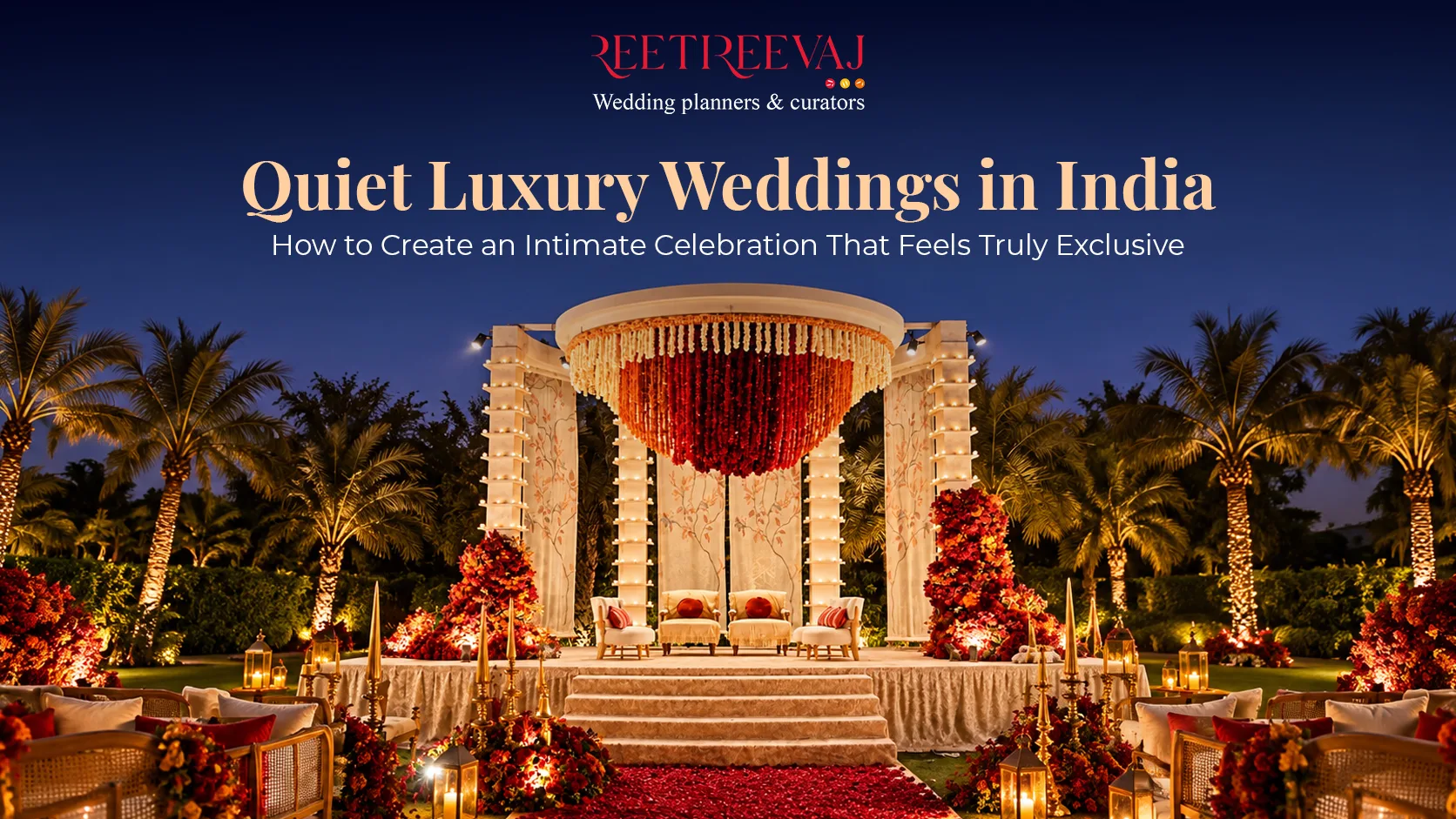
Instead of filling every corner with installations, you invest in a few well-designed features that set the mood: an architectural mandap, carefully chosen florals, warm lighting, elegant tablescapes and cultural details that mean something to your families.
It doesn’t mean thinking small. A grand palace wedding in Jaipur and an intimate celebration in Lonavala can both feel quietly luxurious when the design is cohesive and every detail has a purpose.
Key characteristics include:
- Personalised design: Décor that reflects the couple’s personalities, heritage and preferences.
- Considered colour palettes: Colours that complement the venue and work across every function.
- Quality over quantity: A few well-executed installations instead of many competing elements.
- Thoughtful hospitality: Guest experiences that feel warm, comfortable and well organised.
- Cohesive execution: One visual story across the ceremony, reception, collateral and celebrations.
6 Indian Wedding Themes That Reflect Quiet Luxury
The right theme gives your wedding a clear creative direction. The best Indian wedding theme ideas balance cultural meaning with the couple’s style, the venue’s architecture and the mood you want to create.
1. Contemporary Heritage Elegance
For couples who love Indian architecture and traditional craftsmanship, this theme draws on heritage and interprets it in a modern way.
Think architectural arches, fine metal detailing, traditional textiles, handcrafted accents and carefully placed florals. Rather than recreating a palace, the design takes inspiration from heritage elements and keeps the look clean.
It works especially well at heritage properties, South Mumbai’s sea-facing venues, and palace settings in Rajasthan.
Design tip: Let the venue’s character lead. A strong architectural backdrop may need only good lighting, elegant florals and complementary furnishings.
2. Understated Floral Elegance
Flowers can feel luxurious without covering every surface. Focus on composition, texture and placement rather than sheer quantity.
A restrained palette of ivory, soft blush, muted peach or deeper seasonal tones creates harmony. Save statement arrangements for the mandap, entrance or reception stage, and use smaller floral details to connect the rest of the space.
This theme suits five-star ballrooms, garden venues and intimate celebrations.
Design tip: Mix floral textures with foliage and leave negative space. It adds depth without crowding the décor.
3. Modern Indian Craftsmanship
Indian craft makes wedding décor feel personal and rooted. Handcrafted textiles, embroidery, regional art forms, carved details and local patterns can be woven into seating areas, welcome installations, backdrops, tablescapes and wedding collateral.
The result celebrates Indian heritage without leaning on predictable motifs.
Design tip: Pick a small number of meaningful craft elements and repeat them selectively across the celebration.
4. Architectural Minimalism
Structure, proportion and lighting carry this look. Curved backdrops, sculptural arches, geometric installations and clean stage lines make an impact without heavy ornamentation. Neutrals, metallic accents or one confident statement colour let the architecture stand out.
It’s a natural fit for contemporary hotel ballrooms and modern venues, including the Taj, Oberoi and St. Regis-style properties couples often choose in Mumbai.
Design tip: Check the scale of every structure. A backdrop should complement the room, not overwhelm it.
5. Intimate Garden Luxury
Garden-inspired weddings work with the landscape instead of replacing it. Existing greenery, natural light and open space do half the work, and the décor builds on them.
Floral pathways, elegant outdoor seating, layered lighting and thoughtfully arranged dining spaces suit intimate ceremonies, welcome dinners and smaller receptions, especially at resort venues around Lonavala, Igatpuri and Karjat.
Design tip: Plan for weather, ground conditions, guest movement and a solid backup arrangement before the design is final.
6. Destination-Inspired Personalisation
A destination wedding can reflect its location while carrying details from the couple’s own story. A coastal celebration in Goa might lean on natural textures and an open, airy layout, while a wedding in Udaipur or Jaisalmer can draw on local architecture, regional crafts and traditional colours.
The aim is to create a sense of place without turning the venue into a collection of unrelated references.
Design tip: Let the destination shape the palette, materials, food and guest experiences, while the concept stays personal to you.
Exploring the planning side of a premium celebration? Start with our guide to luxury wedding planners in India.
How to Create Grand Wedding Decorations Without Overdoing Them
Grand wedding decorations feel sophisticated when there’s a clear visual hierarchy. Instead of making every part of the venue a focal point, decide which spaces matter most and build the décor around them. At ReetiReevaj, our Production of Decor & Design team often shares 3D visualisations early on, so couples can see how a setup will look in the actual space before anything is built.
Establish a Clear Focal Point
Every celebration benefits from one central visual feature: the mandap, reception stage, entrance installation or dining area. Once that’s set, the surrounding décor supports it through colour, material and lighting.
Choose a Cohesive Colour Palette
Start with one dominant colour, add supporting shades and use accents sparingly. Look at the venue’s flooring, walls, furniture and existing lighting before you decide. Colours that look beautiful on a moodboard can shift under artificial light or against a venue’s finishes.
Use Lighting to Create Depth
Lighting can change a venue without adding a single prop. Warm ambient light, spotlights, backlighting and architectural illumination bring out texture and set the mood for each part of the evening. It should also work for photography and videography while keeping guests comfortable.
Balance Statement Elements With Open Space
Luxury needs breathing room. Too many structures, floral installations and props make even expensive décor feel busy. Keep the surrounding areas simpler so the main installations stand out, and keep guest pathways clear.
Make Each Function Feel Distinct
In a multi-day Indian wedding, each function can have its own identity while belonging to the same story. A daytime mehendi might be lively and handcrafted, while the cocktail night or reception turns more structured and evening-led. Shared design cues tie the functions together without making every setup look the same.
More inspiration in our guide to Indian wedding decoration ideas.
Grand Reception Stage Decoration: How to Make It Feel Personal and Refined
The reception stage is often the visual centre of the evening. It shows up in couple portraits, family photographs and guest videos, so its design matters.
But a grand reception stage decoration doesn’t have to mean an oversized floral wall. A well-designed stage balances the couple’s taste, the venue’s architecture, lighting and practical needs.
Choose a Backdrop That Complements the Venue
The backdrop should suit the room’s proportions. Tall structures work in spacious ballrooms, while restrained installations can look stunning in smaller spaces. Arches, layered fabrics, florals, geometric structures and contemporary heritage details can all be adapted to your theme.
Personalise the Stage
A subtle monogram, a meaningful motif, a nod to the couple’s heritage or a detail inspired by their story can all work. Personalisation should feel built into the stage, not added at the last minute.
Coordinate Lighting and Photography
The stage has to look good in person and on camera. Lighting should bring out the backdrop’s detail, flatter the couple’s outfits and avoid harsh shadows or reflections. Plan camera angles, stage depth, guest sightlines and photographer positions before the setup is final.
Keep the Guest Experience in Mind
The stage shouldn’t block views or create bottlenecks. Think through the couple’s seating, family photographs, guest access and transitions between programme segments, and bring in entertainment and artist timings so nothing clashes on the night.
See more concepts in our guide to modern reception stage decoration ideas for luxury Indian weddings.
Beyond Décor: Entertainment, Catering and Personal Touches
Quiet luxury isn’t only about how a wedding looks. It’s also about how it feels, and a few well-chosen touches do more than a dozen add-ons.
- Entertainment & artists: Live bands, DJs, anchors and performers that match the mood of each function, not just the budget.
- Catering selection: Menus and live counters chosen with your families’ tastes in mind, presented to match the styling.
- Experiential moments: Small, memorable touches such as a petal bar, a bell-ringing moment during the pheras or an artist counter with caricatures and bangle-making give guests something to talk about.
- Gifting & collateral: Invitations, welcome hampers and signage that carry the wedding’s design language from the first invite to the final send-off.
Guest Experience: Wedding Websites, RSVPs and Hospitality
A wedding begins well before guests reach the venue. An Indian wedding website is a simple way to share the essentials and introduce guests to the style of your celebration, especially for multi-day and destination weddings where people are travelling in from Mumbai, Delhi, abroad and everywhere in between.
What Should a Wedding Website Include?
- The couple’s story: A short, warm introduction.
- Event itinerary: Dates, timings, venues and dress-code guidance for each function.
- Travel and accommodation: Directions, hotel details, transfers and arrival guidance.
- RSVP details: An easy way for guests to confirm attendance and share any requirements.
- Practical information: Contact details, venue maps and answers to common questions.
Keep It Consistent With the Wedding Theme
Typography, colours, imagery and tone on your website and invitations can echo the wedding’s design. A heritage wedding might use traditional motifs and refined type, while a contemporary one suits clean layouts and minimal styling.
Let Someone Own the Logistics
A website shares information, but it doesn’t book flights or sort out room blocks. That’s where a hospitality and logistics team comes in. At ReetiReevaj, our hospitality and logistics team manages guest flights, airport transfers, hotel room blocks, RSVPs and on-ground support, so your guests are looked after across every function. Our gifting and collateral service takes care of invitations and hampers so they match the rest of the design.
How to Bring Every Wedding Detail Together
A wedding feels cohesive when the theme travels across touchpoints in a considered way, not when it’s repeated identically everywhere. Use this checklist to keep design and planning aligned.
| Wedding element | What to consider |
| Venue and layout | Architecture, capacity, guest movement and practical limits |
| Colour palette | Consistent colours across décor, florals, collateral and styling |
| Ceremony décor | Mandap design, seating, florals and lighting |
| Reception stage | Backdrop proportions, personalisation, photography and visibility |
| Guest experience | Invitations, RSVPs, travel guidance, room blocks and hospitality |
| Dining and tablescapes | Table styling, menu presentation and comfortable seating |
| Entertainment | Artists, performers and function-wise show flow |
| Event coordination | Timelines, vendor responsibilities, setup and transitions |
| Contingency planning | Weather, technical needs and backup arrangements |
Planning a Quiet Luxury Wedding in India: What Couples Should Know
A sophisticated wedding needs more than a strong concept. The venue, guest list, cultural requirements, production timelines and vendor coordination all have to work together.
Before finalising the design, think about:
Booking timelines: For peak-season dates between October and March, book your planner 8 to 12 months ahead, as the best venues and vendors fill up first. For destination weddings, 10 to 12 months is ideal.
Venue compatibility: Confirm that installations suit the venue’s dimensions, access rules and technical requirements.
Guest comfort: Plan seating, circulation, temperature, accessibility and transport around the venue and guest profile.
Cultural preferences: Talk through the rituals, family traditions and personal details that matter most before the concept is developed.
Photography requirements: Consider how décor, lighting and the stage will look in photographs and videos.
Destination logistics: For weddings away from home, account for material transport, installation schedules, local suppliers and weather.
End-to-end coordination: Design, production, hospitality and the event schedule should work as one. A beautiful setup should also run smoothly through the celebration.
These matter even more for destination weddings and celebrations with multiple functions or venues.
How ReetiReevaj Helps Create Personalised Luxury Weddings
ReetiReevaj is a Mumbai-based wedding planning company with a dedicated team and office in Jaipur. Founded by Varsha Kasera (about us), we plan weddings across Mumbai’s most prestigious venues and destination locations such as Udaipur, Jaipur, Goa, Jaisalmer, Kerala, Lonavala and Igatpuri.
Our approach is simple: one team, every detail. Our services cover:
- End-to-end wedding planning
- Destination and venue selection
- Hospitality and logistics
- Production of décor and design
- Entertainment and artists
- Catering selection
- Gifting and collateral
Whether you want a contemporary Indian theme, a refined heritage setting, a grand reception or an intimate destination celebration, we start with your priorities and shape them into one cohesive experience, so you can enjoy your wedding as a guest.
Explore ReetiReevaj to see our portfolio and learn more about how we work.
Frequently Asked Questions
1. What is a quiet luxury wedding?
A quiet luxury wedding focuses on refined design, thoughtful details, personalised experiences and seamless coordination rather than excessive decoration. It can be intimate or grand. What defines it is a cohesive celebration where the venue, styling, hospitality and cultural elements work together.
2. What are some elegant Indian wedding theme ideas?
Contemporary heritage, understated floral elegance, modern Indian craftsmanship, architectural minimalism, garden-inspired celebrations and destination-led concepts all work well. The best theme reflects your personality, cultural preferences, venue and the atmosphere you want.
3. How can grand wedding decorations look sophisticated?
Start with a clear focal point, a coordinated colour palette and a balance between statement installations and open space. Quality materials, considered lighting and venue-appropriate proportions create a polished look without crowding the setting.
4. What should couples consider when planning grand reception stage decoration?
Think about the venue’s dimensions, backdrop style, lighting, photography angles, guest visibility and your own preferences. The stage should complement the wider décor while staying practical for seating, photographs and programme transitions.
5. Why should couples create an Indian wedding website?
An Indian wedding website gives guests event schedules, venue details, travel information, accommodation guidance and RSVP instructions in one place. It’s especially useful for destination weddings and multi-day celebrations, where guests need to coordinate travel and attendance.
6. Can traditional Indian wedding themes feel modern?
Yes. Traditional motifs, regional craftsmanship, textiles and cultural elements can be styled with contemporary layouts, restrained palettes and modern lighting. The result respects Indian wedding traditions while reflecting your individual style.
7. How do couples keep a consistent theme across multiple wedding functions?
Set an overall creative direction, then adapt it to each function. Colours, materials, motifs and typography connect the events, while different florals, lighting and layouts give each celebration its own character.
8. How can a wedding planner help create a personalised luxury wedding?
A planner turns your vision into a workable plan, coordinates décor and production, manages vendors, organises hospitality and oversees execution. With end-to-end planning, one team handles venue and date selection, budgeting, décor, catering, entertainment, guest travel and every function.
9. How far in advance should I book a wedding planner?
Book 8 to 12 months ahead for peak-season dates between October and March, when the best venues and vendors fill up first. For destination weddings, 10 to 12 months is ideal.
Conclusion: A Wedding That Reflects Your Story
A quiet luxury wedding isn’t defined by how much decoration fills a venue. It’s defined by how thoughtfully the celebration comes together.
From choosing meaningful Indian wedding themes to refining grand wedding decorations, designing a memorable reception stage and looking after every guest, each detail adds to a wedding that feels personal and complete.
The best celebrations balance tradition with personal taste, beauty with guest comfort, and creative ambition with careful execution.
Planning a wedding in Mumbai, Jaipur or a destination elsewhere in India? ReetiReevaj can help you bring your vision to life with considered design and end-to-end wedding planning. Visit ReetiReevaj and book an appointment to start planning your celebration.