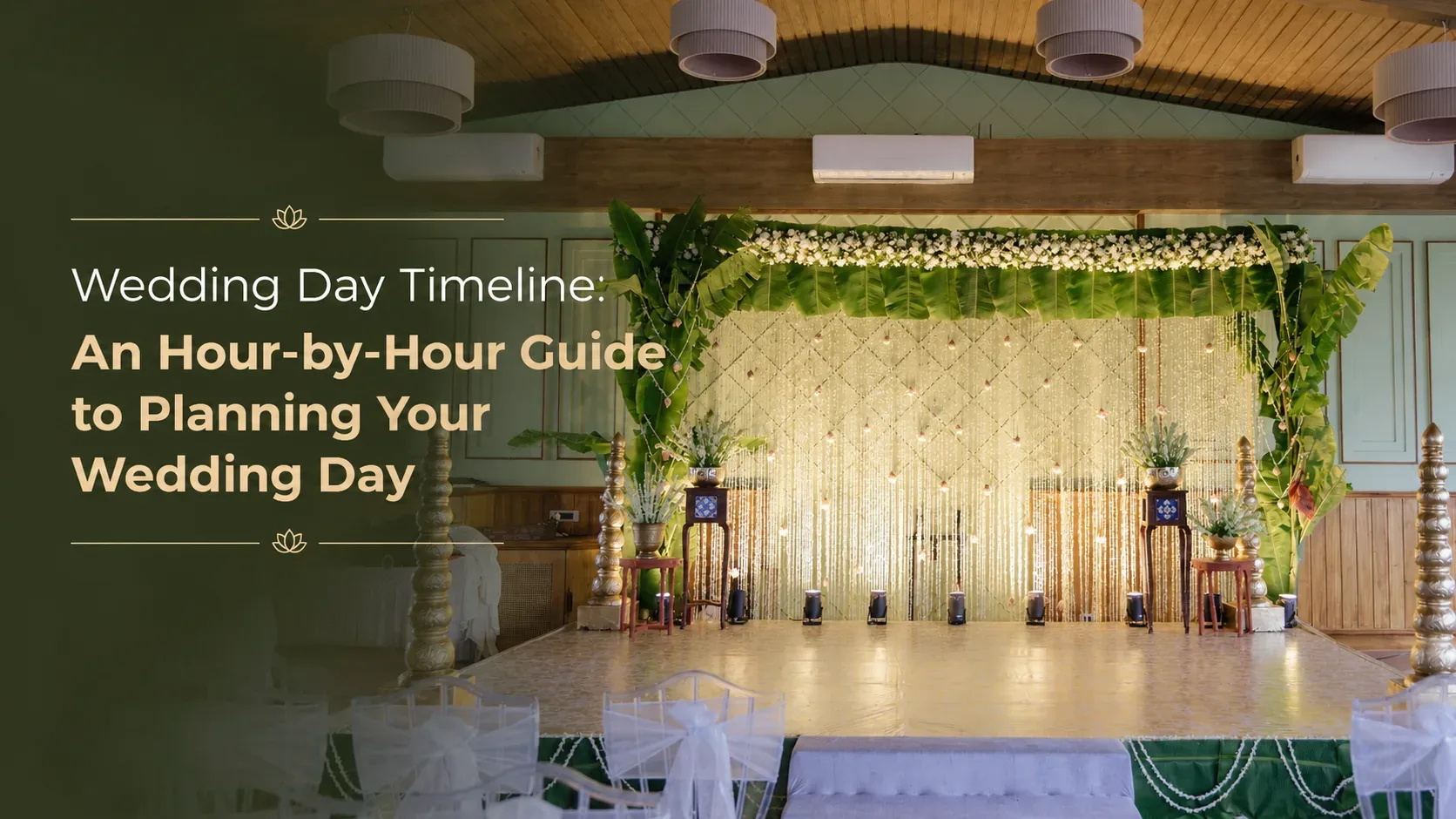
A wedding day timeline is the hour-by-hour schedule that maps out exactly when each part of your wedding happens from the first cup of chai during getting-ready to the last dance at the reception. It’s the difference between a day that flows and a day that feels like a scramble. If you’ve ever heard a bride say her wedding “just went by in a blur,” a good timeline is usually why it felt calm instead of chaotic.
For couples planning a luxury or destination wedding in India, where a single day can carry multiple rituals, outfit changes, vendor teams, and hundreds of guests, a wedding day timeline isn’t a nice-to-have. It’s the backbone of the entire celebration — and it’s exactly the kind of detail Reetireevaj’s wedding planning and coordination services are built around.
What Is a Wedding Day Timeline?
A wedding day timeline — sometimes called a run-of-show — is a detailed, minute-by-minute or hour-by-hour breakdown of everything happening on your wedding day. It’s different from a general wedding event flow, which usually just lists the big moments (baraat, pheras, reception) in order without specifying timing, buffers, or who’s responsible for what.
A true run-of-show goes deeper. It tells the makeup artist what time the bride needs to be ready by. It tells the photographer when the couple’s portraits are scheduled so they don’t clash with the caterer’s lunch service. It tells the venue team when to start setting up the mandap for the next ceremony. Every vendor, every family member, and every guest touchpoint has a place on this single document.
Think of the wedding day timeline as the operating manual for your wedding — one that keeps ceremony, photography, guest experience, and vendor coordination moving in sync, rather than working against each other.
Sample Hour-by-Hour Wedding Day Timeline
This is an illustrative sample for a single-day, morning-to-evening celebration. Your actual timings should be built around your own rituals, venue, guest count, and traditions — no two weddings run on the same clock, and elements like wedding decor and production design often dictate their own setup and reveal windows within the day.
| Time | Wedding Activity | What Happens | Planning Notes |
| 6:00 AM | Getting ready, hair and makeup | Bride and groom begin hair, makeup, and styling in separate spaces | Start earlier for elaborate bridal looks or large bridal parties; keep a light breakfast ready |
| 7:30 AM | Bridal and groom portraits | Solo and getting-ready photography and videography | Natural morning light works best; confirm the shot list with your photographer in advance |
| 8:30 AM | Family photographs and preparations | Immediate family gets ready; family portraits before the ceremony rush begins | Assign a family coordinator to keep everyone on time |
| 9:00 AM | Guest arrivals and welcome | Guests are welcomed at the venue with refreshments | Have ushers or a welcome desk in place at least 30 minutes before this slot |
| 9:30 AM | Wedding ceremony and rituals | Core wedding rituals take place as per tradition | Duration varies widely by ritual — confirm the priest’s or officiant’s estimated timing in advance |
| 11:30 AM | Post-ceremony photographs and greetings | Couple portraits, family photos, and guest greetings | Build in extra time here — this stage almost always runs long |
| 12:30 PM | Lunch or guest refreshments | Guests are served lunch while the couple may step away briefly | Stagger service if guest count is high, to avoid queues |
| 2:00 PM | Rest, outfit changes, and preparation | Couple rests and changes for the next event | Non-negotiable buffer — skipping this is the most common timeline mistake |
| 4:00 PM | Evening celebrations or pre-reception activities | Sangeet-style events, cocktail hour, or family gatherings | Confirm sound and lighting checks are done before guests arrive |
| 6:00 PM | Guest arrival and reception welcome | Reception guests begin arriving | Overlap slightly with the previous slot so there’s no dead time |
| 7:00 PM | Couple’s entry and reception celebrations | Grand entry, toasts, and celebratory moments | Coordinate closely with the DJ or emcee on cues |
| 8:00 PM | Dinner and entertainment | Dinner service alongside performances or dancing | Keep entertainment segments tight — 20–30 minutes per act |
| 10:00 PM | Closing moments and guest departures | Final dances, farewells, and wrap-up | Confirm vendor load-out and transport for the couple in advance |
This is a sample timeline only. Your wedding planner will adjust every slot based on your specific rituals, ceremony length, venue logistics, and personal preferences.
How to Customize Your Wedding Day Timeline
No two weddings run on the same schedule, and your timeline should reflect that. A few factors that reshape the hour-by-hour plan:
Morning versus evening weddings. A morning wedding needs the getting-ready process to start well before sunrise, while an evening wedding shifts the entire day toward late-afternoon prep and a longer daytime buffer.
Traditional Indian wedding rituals. Ceremonies like the haldi, mehendi, or pheras each carry their own duration and significance, and a timeline needs to honor that pacing rather than rushing sacred moments to stay “on schedule.”
Multi-event, multi-day celebrations. When a wedding spans several days — sangeet one evening, wedding ceremony the next morning, reception the night after — each day needs its own timeline that still connects to the overall celebration flow.
Destination weddings and resort venues. Travel time between guest accommodations and ceremony spaces, weather windows, and local vendor availability all shape the schedule differently than a single-venue city wedding. Popular getaways like a wedding in Karjat or a wedding in Lonavala each come with their own travel rhythms and venue-specific timing quirks that a local planning team accounts for from the start.
Guest count and venue layout. A 150-guest ceremony moves very differently from an 800-guest one — larger gatherings need more buffer for movement, seating, and service.
Photography, entertainment, and outfit changes. Every additional look or performance adds real time to the day, and each should be accounted for individually rather than estimated in a single lump slot.
How Much Buffer Time Should You Include?
Buffer time is the single most underestimated element of a wedding day timeline — and the one that saves the day when things don’t go exactly to plan.
A general rule of thumb is to build in 15–30 minutes of buffer around every major transition: after getting ready, after the ceremony, before the reception entry. Photography and family portraits, in particular, almost always take longer than planned, simply because there are more people, more requests, and more moments worth capturing than anyone accounts for on paper.
Buffer time isn’t wasted time. It’s what allows a late hair appointment, a delayed vendor, or an emotional family moment to happen without collapsing the rest of the day. The couples who feel most relaxed on their wedding day are rarely the ones with the tightest schedule — they’re the ones with the most realistic one.
Who Manages the Wedding Day Timeline?
A wedding day timeline only works if someone owns it — and on a day with this many moving parts, that’s rarely a job for the couple or their family.
The wedding planner builds the master timeline and shares tailored versions with each vendor, so the photographer, caterer, and decorator are all working off the same clock. The venue team manages space transitions — turning a ceremony area into a reception space, for instance — within the windows the timeline allows. Makeup artists and stylists work backward from the first photography or ceremony slot to know exactly when to start. Photographers and videographers coordinate shot lists against the schedule so nothing is missed. Caterers time service around ceremony and reception flow, so guests are never left waiting — or rushed. And the entertainment team, whether that’s a live band or entertainment artists booked for a specific segment, keeps performances and music cues aligned with the couple’s key moments.
This is where a team offering end-to-end wedding planning earns its keep — coordinating every one of these moving parts under one schedule, and adjusting in real time when something shifts.
Common Wedding Timeline Mistakes to Avoid
Even well-organized couples fall into a few recurring traps when building their run-of-show:
- Scheduling events too close together, leaving no room for delays or transitions
- Underestimating makeup and outfit-change time, especially for elaborate bridal looks
- Ignoring guest movement between venues or spaces, which takes longer than expected with larger groups
- Forgetting to schedule photography and family portraits as their own dedicated slots
- Not accounting for meals and guest comfort, leading to long, unstructured waiting periods
- Failing to share the finalized schedule with every vendor, so teams work off outdated or inconsistent timings
Most of these mistakes come from planning the day as a list of events rather than a connected sequence — where one delay ripples into the next.
Tips for a Smooth Wedding Day
- Share the final timeline with every vendor at least a week in advance, not just the day before
- Appoint one point of contact — ideally your planner — to handle real-time schedule changes so the couple doesn’t have to
- Build slightly more buffer into the first few hours of the day, since early delays compound as the day goes on
- Keep a printed or shared-device copy of the timeline accessible to family members helping coordinate
- Trust the schedule, but stay flexible — a wedding day rarely runs to the exact minute, and that’s fine
How Reetireevaj Helps Plan Your Wedding Day
At Reetireevaj, coordinating a wedding day timeline is where planning meets execution. Every detail on the schedule — the ceremony timings, vendor handoffs, guest movement, and reception transitions — is mapped in advance and managed on the day itself, so couples can be fully present in their own celebration instead of managing logistics.
From venue selection to the final send-off, our approach spans full destination venue selection support and end-to-end coordination. You can see how this comes together across real celebrations in our portfolio.
Conclusion
Your wedding day only happens once, and the difference between living it fully and spending it watching the clock often comes down to one thing: a timeline built with enough detail and enough buffer to actually work. Whether you’re planning an intimate morning ceremony or a multi-day destination celebration, a clear hour-by-hour schedule — backed by a team that manages it in real time — is what lets you enjoy every moment instead of chasing the next one.
If you’re starting to plan your wedding day timeline, Reetireevaj would love to help you build one that fits your celebration, your rituals, and your vision. Reach out to Reetireevaj to start planning your wedding day, hour by hour.
FAQ
1. What is a wedding day timeline?
A wedding day timeline is a detailed, hour-by-hour or minute-by-minute schedule of everything happening on your wedding day, from getting ready to the final reception moments. It coordinates couples, family, and vendors around one shared schedule.
2. How do you create an hour-by-hour wedding day schedule?
Start by listing every major event of the day — getting ready, ceremony, photography, meals, reception — then work backward from fixed points like ceremony timing to slot in preparation, buffer, and transition time for each.
3. How much buffer time should you include in a wedding timeline?
A general guideline is 15–30 minutes of buffer around each major transition, with extra time built into photography and family portrait slots, since these consistently run longer than planned.
4. How long does a traditional Indian wedding ceremony take?
This varies significantly by tradition and region — some ceremonies last under an hour, while others, with multiple rituals, can run two to three hours or more. Your priest or officiant is the best source for an accurate estimate for your specific rituals.
5. Who manages the wedding day run-of-show?
A wedding planner typically owns the master timeline and coordinates it with the venue team, makeup artists, photographers, caterers, and entertainment vendors to keep the day on schedule.
6. When should a wedding day timeline be finalized?
Most planners recommend finalizing the timeline two to three weeks before the wedding, once vendor confirmations, ceremony timings, and guest counts are settled, with only minor adjustments after that.
7. How do you plan a wedding day timeline for a destination wedding?
Destination wedding timelines need extra buffer for guest travel between accommodations and venues, weather-dependent outdoor events, and coordination with local vendors — all built around the resort or venue’s own operational schedule.