A dual-ritual wedding timeline is built by listing each family’s
non-negotiable rituals, confirming their correct order and realistic
duration with both families and officiants, grouping rituals that can
sit together, keeping ceremonies that must stay separate distinct,
adding transition buffers, planning guest movement, meals,
photography and entertainment around the ceremonies, and assigning
one team to keep the sequence on time.
Introduction
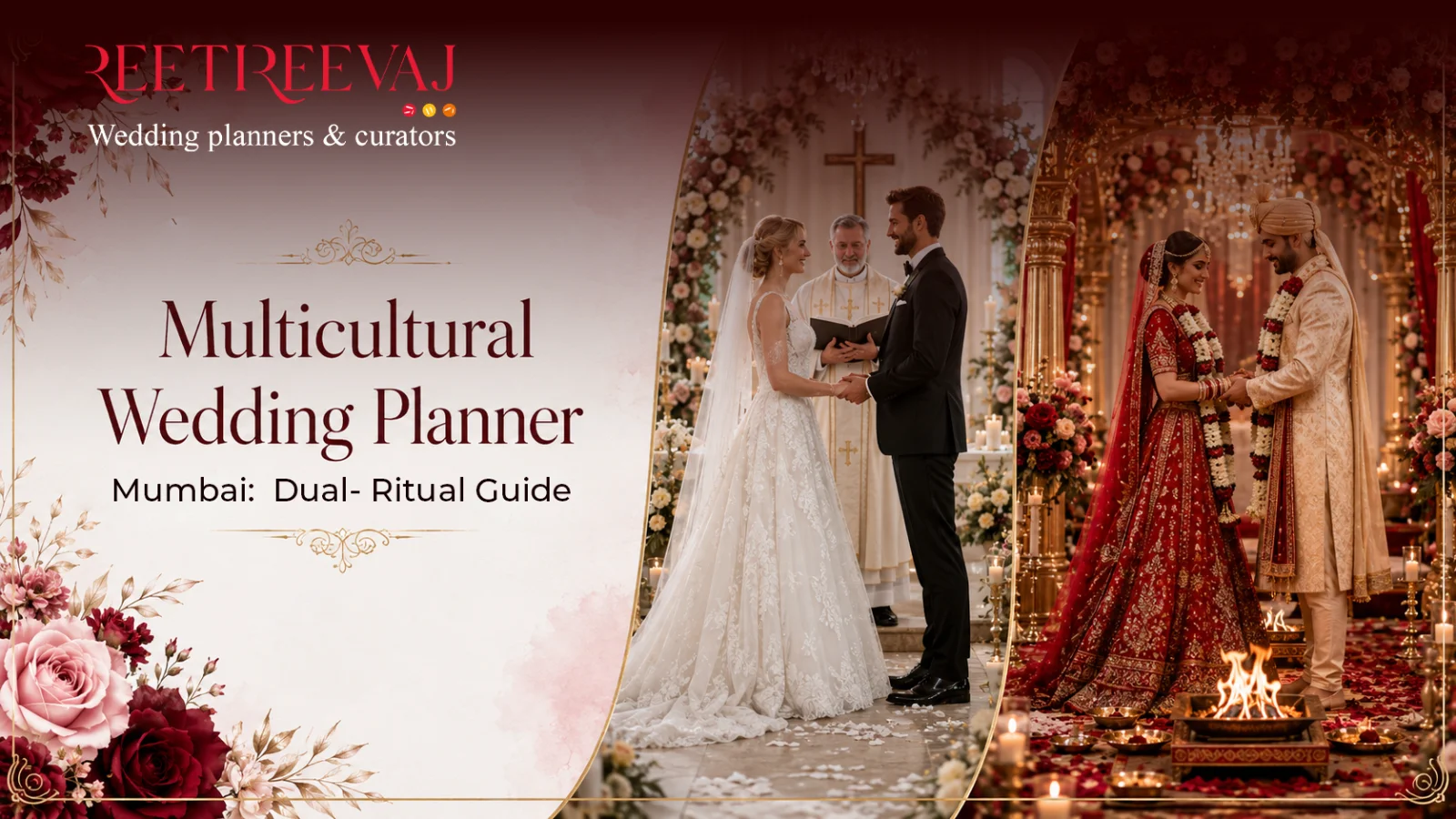
A multicultural or interfaith wedding in Mumbai usually requires two traditions to be documented, sequenced and produced without reducing either one. The planner’s job is to coordinate ceremony timing, priests or officiants, family expectations, venue transitions, guest communication and hospitality so both sides feel represented and the wedding still runs as one coherent celebration.
Both families are usually happy. Both want the wedding to happen.
What differs is the detail: the hour the ceremony should begin,
how long it runs, who must be seated where, what the food should be,
whether music plays during the rites, what the couple wears and who
leads which moment.
None of this is a disagreement about love. It is a sequencing problem,
and sequencing problems have solutions.
The work of a multicultural wedding planner Mumbai is to convert
two complete ritual traditions into one operational plan in which
neither side is asked to compress, postpone or quietly drop something
that matters to them. This guide explains how that plan is actually built.
What Is a Multicultural or Interfaith Wedding?
A multicultural wedding brings together two cultural or community
traditions, often within the same religion. A Gujarati family and a
Tamil family may both be Hindu, yet follow very different ritual
sequences, timings, languages and customs.
An interfaith wedding involves families from different religious
traditions, which usually means two separate ceremonies led by two
different officiants.
The distinction matters because it changes the planning approach.
Multicultural weddings often need careful blending across functions.
Interfaith weddings usually need two intact ceremonies with a
well-designed link between them.
Every family practises its traditions slightly differently. The exact
rites, order and duration must always be confirmed with the families
and their priest, clergy or officiant before anything is scheduled.
Why Combining Two Traditions Is Harder Than Simply Adding Functions
Adding a second ceremony to a wedding is not the same as adding a
second event. It changes almost every operational layer underneath.
- Ritual duration: A ceremony that families describe as “about an hour” often runs longer once family participation is included.
- Auspicious or religious timings: Where a muhurat or a fixed service time applies, the rest of the day has to be planned around it.
- Venue hours: Two ceremonies plus a reception can exceed a standard banquet booking window.
- Outfit changes: Bridal changes with jewellery and hair rarely take less than forty-five minutes.
- Décor changeovers: Converting a mandap setting into a church-style or aisle-led setting is a production job with a real timeline.
- Guest fatigue: Elderly guests and children cannot comfortably sit through five continuous hours.
- Photography: Two ceremonies mean two full coverage briefs plus family portrait sessions for both sides.
- Catering: Meal windows have to sit between rituals, not collide with them.
- Processions and entertainment: A baraat, a choir, a band or a dhol team each needs a load-in slot and a sound plan.
- Sound restrictions: Mumbai venues have their own cut-off timings, which affects how late a celebration can run.
- Travel across the city: A hotel-to-venue transfer that takes twenty minutes at noon can take fifty at 7 pm.
The goal of multicultural wedding planning is not to compress two
ceremonies into one. It is to design one celebration in which both
traditions retain their meaning.
How to Build a Dual-Ritual Wedding Timeline Without Cutting Either Tradition
Here is the framework our planning team uses when two ritual traditions
have to sit inside one wedding.
Step 1: Create Two Separate Ritual Inventories
Do not begin by combining. Begin by documenting each tradition
independently, as though it were the only ceremony taking place.
Build one sheet per family with these columns:
| Column | What it captures |
|---|---|
| Ritual | Name as the family uses it |
| Who participates | Couple, parents, siblings, specific relatives |
| Importance | Sacred, customary or celebratory |
| Preferred timing | Fixed muhurat, morning, evening, flexible |
| Approximate duration | Confirmed with the officiant, not estimated |
| Venue requirement | Mandap, altar, open space, indoor, water access |
| Items required | Ritual items, offerings, fabrics, fire, rings |
| Officiant required | Yes or no, and who |
| Audio requirement | Chanting, hymns, silence, live music |
| Photography | Permitted, restricted or discreet only |
| Can run alongside another activity | Yes or no |
That last column does most of the work later. It is the difference
between a ceremony that can share a room with guest movement and one
that requires the room’s full attention.
Step 2: Mark the Non-Negotiables
Speak to each family separately at this stage. People answer more
honestly when they are not negotiating in real time.
Ask both sides:
- Which ceremonies must take place, without exception?
- Which sequence cannot be reordered?
- Does anything require a specific time or a specific day?
- Which family members must be present for each ritual?
- Which customs require a priest, clergy member or officiant?
- Which moments must not overlap with guest activity such as cocktails or dining?
Do this before décor concepts, entertainment bookings or run-of-show
drafts are finalised. Reversing a signed artist slot or a fabricated
set because a ritual timing was confirmed late is expensive and avoidable.
Step 3: Identify the Genuinely Shared Moments
Some parts of a wedding belong to the celebration rather than to
either ritual tradition. These are usually the easiest to share.
Depending on the families, shared elements may include the welcome,
the couple’s entrance, family introductions, the reception, dinner,
speeches, photography and entertainment.
Sacred rites are a separate category. They are not merged by default,
and they should never be blended simply because it looks elegant on
a floor plan. Any blending happens only where both families and both
officiants have specifically agreed to it.
Step 4: Keep Rituals Separate Where Separation Protects Their Meaning
Successful multicultural planning does not require physically merging
everything.
Ceremony A → Transition → Ceremony B → Shared Celebration
Each tradition gets a clean start, undivided attention and a proper
conclusion. Guests understand what they are watching. Officiants are
not working around each other. Photographers know exactly where to be.
Neither family sits through a hybrid version of something they recognise.
Step 5: Build Transition Buffers
Buffers are where most dual-ritual timelines fail. A schedule with no
slack does not run early, it runs late from the second ceremony onwards.
- Bridal outfit and jewellery change: 45 to 60 minutes
- Groom’s change: 20 to 30 minutes
- Mandap or stage conversion: 60 to 90 minutes, longer for floral resets
- Guest seating reconfiguration: 20 to 30 minutes
- Vendor reset and technical recheck: 30 minutes
- Family and couple portraits: 30 to 45 minutes per side
- Officiant arrival, briefing and departure windows
- Rest, hydration and a meal for the couple
- Assisted movement for elderly guests between spaces
These ranges are planning guidance. Actual durations depend on the
venue, the scale of the décor and the number of guests, and should be
confirmed during the site recce.
Step 6: Build Hospitality Around the Ritual Timeline
Guests judge a wedding by how they were looked after between the
ceremonies, not during them.
- Welcome refreshments on arrival
- Tea and snacks positioned during long changeovers
- Meal windows that sit between rituals
- Shaded or seated areas for elderly guests
- A quiet area for children and their families
- Clear signage in both families’ languages where useful
- Ushers briefed on what is happening
- Transport slots planned around Mumbai traffic
- Room allocations grouped so families are not split across floors
Never leave guests waiting hungry because a ceremony ran longer than
expected. Ritual overruns are normal. A hospitality plan that assumes
perfect timing is not.
Step 7: Create One Master Run-of-Show
A dual-ritual wedding needs a single operational document that every
team works from. Not three versions. One.
The run-of-show should be issued to the couple, both families, the venue,
the décor and production team, catering, photography, entertainment,
hospitality, the officiants and transport.
| Time | Activity | Owner | Note |
|---|---|---|---|
| 16:00 | Vendor load-in complete, technical check | Production | Sound test before guest arrival |
| 17:30 | Guest arrival, welcome refreshments | Hospitality | Ushers briefed on ceremony order |
| 18:15 | Ceremony 1 begins | Officiant 1 | No service movement during rites |
A dual-ritual wedding timeline should be built around the rituals first
and the entertainment schedule second.
Worked Example 1: A Hindu and Christian Wedding in Mumbai
Illustrative Example
Actual rituals and timings must be confirmed with the families
and their officiants.
A same-day format with two intact ceremonies and one shared celebration.
| Time | Activity | Planning Note |
|---|---|---|
| 07:00 | Vendor load-in, ceremony space 1 set | Production and floral teams report early |
| 09:00 | Couple and family preparation | Separate rooms, stylists briefed on two looks |
| 10:00 | Guest arrival, welcome refreshments | Ushers explain the day’s sequence |
| 10:45 | Ceremony 1 begins, led by the family’s officiant | Duration confirmed in advance |
| 12:30 | Ceremony 1 concludes, family portraits | Photographer briefed on both families |
| 13:00 | Lunch service for guests | Menu planned for both families |
| 13:00 | Couple’s outfit change and rest | Meal sent to the room |
| 13:00 | Space conversion for Ceremony 2 | Runs parallel with lunch |
| 15:00 | Guests seated for Ceremony 2 | Order of service shared in print or signage |
| 15:30 | Ceremony 2 begins | Both officiants briefed on timing |
| 16:45 | Ceremony 2 concludes, combined family portraits | Both sides given equal portrait time |
| 17:30 | Tea and refreshments, guest movement to reception | Elderly guests assisted first |
| 19:00 | Reception, couple’s entrance, dinner, entertainment | Shared celebration |
Why this sequence works.
Neither ceremony is shortened. The lunch window doubles as the
changeover window, so guests are eating while the production team
resets rather than standing around watching it happen. The couple gets
a genuine rest before the second ceremony. Both officiants know exactly
when they are needed and when they are not.
Worked Example 2: A Gujarati and Tamil Wedding in Mumbai
Illustrative Example
Actual rituals and timings must be confirmed with the families and
their priests.
Both families here may be Hindu, yet the ceremonies, timings and
customs can differ substantially. A two-day format usually serves
this pairing better than one compressed day, particularly where
early-morning muhurats apply to one side.
| Time | Activity | Planning Note |
|---|---|---|
| Day 1 | Pre-wedding schedule | |
| 09:00 | Pre-wedding functions for family A | Rituals and participants confirmed |
| 13:00 | Lunch | Regional menu reflecting family A |
| 16:00 | Décor changeover for evening function | Production window kept clear |
| 19:00 | Shared sangeet or cocktail evening | Both families’ music and languages |
| Day 2 | Main wedding schedule | |
| 05:30 | Vendor and floral setup | Early call where an early muhurat applies |
| 06:30 | Pre-ceremony rituals for family B | Confirmed with family’s priest |
| 07:30 | Main ceremony | Timing anchored to the muhurat |
| 10:30 | Ceremony concludes, breakfast service | Guests fed immediately after the morning |
| 11:30 | Family portraits and rest | Separate rest space for elderly guests |
| 18:00 | Reception with both families hosting | Emcee briefed to acknowledge both traditions |
Why this feels less rushed.
Spreading the functions across two days lets each family’s ceremonies
run at their own pace, with their own guests fully present and their
own customs given proper attention.
Same Day or Separate Days: Which Works Better?
Neither format is universally better. The right answer depends on the
two ceremonies involved.
A same-day format may work when:
- Both ceremonies are relatively compact
- Both officiants agree on the sequence and are available on the same date
- The venue allows enough hours for two ceremonies plus a reception
- Guest lists overlap substantially
- Changeovers are manageable within the space available
Separate ceremonies or separate days may work better when:
- Both ceremonies are substantial in duration
- Major venue or stage resets are required
- Outfit changes are significant
- Guest groups differ meaningfully
- Auspicious timings or fixed service hours conflict
- Each family wants its tradition to have undivided attention
How to Make Both Families Feel Equally Represented
Representation is felt in the details, not announced in a speech.
- Invitations: both families named with equal prominence
- Signage: welcome and directional signage in both languages where useful
- Ceremony explanations: explain what guests are about to witness
- Food: both cuisines properly represented
- Music: both traditions represented in music and performances
- Décor: design language drawing from both aesthetics
- Family roles: equivalent ceremonial roles for elders
- Stage and entrance time: balanced across functions
- Emcee: briefed on names, pronunciations and ritual significance
The test is simple. If one family would describe the wedding as
“their function that we attended”, the balance is not right yet.
How Modern Luxury Styling Works With Traditional Rituals
Contemporary production and traditional ritual are not in tension.
They operate on different layers.
Modern styling should shape presentation and guest experience:
lighting design, floral architecture, stage build, seating comfort,
signage, sound quality, entertainment production and hospitality standards.
It should not reshape the ritual itself. Décor is designed around
what the ceremony requires, so a mandap is built to the dimensions
the rites need and an altar setting is designed to the officiant’s
requirements, not to a mood board.
The
production of wedding décor and design
work on a dual-ritual wedding is largely about changeover engineering:
designing two settings that can be built, converted and reset inside
the windows the timeline allows.
What Does a Multicultural Wedding Planner in Mumbai Actually Manage?
- Ceremony mapping and ritual documentation for both families
- Family meetings, including separate conversations before joint ones
- Ritual sequencing and timeline construction
-
Venue selection
matched to two ceremonies plus a reception - Vendor sourcing, briefing and coordination
- Décor design, fabrication and changeover production
-
Guest hospitality and logistics
,
including room blocks, transfers and RSVPs - Artist and entertainment scheduling around ritual timings
- Catering coordination and meal window planning
- Bride and groom movement, changes and rest
- Priest, clergy and officiant coordination
- Technical setup, sound and lighting
- Contingency planning for overruns, weather and vendor delays
- On-ground execution across every function
Reetireevaj works across all of these through its
end-to-end wedding planning services
,
with a Mumbai team led by founder Varsha Kasera and over nine years
of experience across 425+ weddings.
How to Choose a Luxury Multicultural Wedding Planner in Mumbai
Multi-function experience matters more than portfolio aesthetics here.
Ask these questions before signing:
- How do you document rituals from both families?
- Who creates the final ceremony timeline, and when do we see it?
- Will you coordinate directly with our priests, clergy or officiants?
- How do you make sure one tradition does not get less time than the other?
- How do you manage décor and stage changeovers between ceremonies?
- How do you handle guest food during long ceremonies?
- How do you communicate timelines to both families?
- Who is responsible for ritual items on the day?
- What happens if a ceremony runs forty-five minutes late?
- Will one senior coordinator oversee the complete wedding?
Look for a planner willing to understand both traditions before
proposing a schedule, comfortable working with family elders and
officiants, strong on hospitality operations, and able to produce
function-wise timelines rather than a single-page overview.
Reetireevaj’s
portfolio of weddings
covers multi-day, multi-function celebrations at premium Mumbai venues
including the Taj, Oberoi and St. Regis, along with destination
weddings across India.
Why Local Mumbai Planning Experience Matters
Mumbai adds its own constraints to a dual-ritual wedding.
Travel time between South Mumbai, the western suburbs and the airport
belt varies enormously by hour, which affects guest pickups, officiant
arrivals and vendor load-in slots.
Multi-venue weddings need transfer planning built into the run-of-show,
not arranged on the day. Hotel weddings have fixed load-in windows and
their own sound cut-off timings. Monsoon dates need covered guest
movement planned from the start.
Knowing how the city actually moves is the difference between a
timeline that looks good on paper and one that holds on the day.
That local operating knowledge is a core part of what a
wedding planner in Mumbai
brings to a multicultural celebration.
Varsha Kasera
Founder, Reetireevaj — Wedding Planners & Curators
For multicultural and interfaith weddings, the most important
planning decision is to document both traditions before designing
the schedule. Once every family’s non-negotiable ritual, timing,
officiant and guest requirement is clear, the planning team can
build transitions around the ceremonies instead of asking the
ceremonies to fit around the production.
Planning a Multicultural or Interfaith Wedding in Mumbai?
Two ritual traditions in one wedding is a design problem, and it
is solvable. Document both. Confirm durations honestly. Protect
what must stay separate. Build buffers you will actually need.
Feed your guests. Then produce around all of it.
If you are planning a multicultural or interfaith wedding and want
the sequencing handled properly from the start, the Reetireevaj
team is available to talk through your ceremonies and timelines.
Book an Appointment
Call +91 77388 33419
Email Us
View Google Business Profile
Frequently Asked Questions
What is a multicultural wedding?
A multicultural wedding brings together two cultural or
community traditions in one celebration. The families may
share a religion but follow different ritual sequences,
timings, languages, cuisines and customs. Each family’s exact
practices should be confirmed directly with them.
What is an interfaith wedding?
An interfaith wedding is one where the couple or their families
come from different religious traditions. It usually involves
two ceremonies led by two different officiants, either on the
same day or on separate days, followed by a shared celebration.
How do you combine two wedding traditions without cutting rituals?
Document each tradition independently first, confirm the
required order and realistic duration with both families and
their officiants, then sequence the ceremonies with proper
transition buffers. Most successful dual-ritual weddings keep
both ceremonies intact and separate, and share the celebration
elements around them.
Can two different wedding ceremonies happen on the same day?
Yes, provided both ceremonies are reasonably compact, both
officiants agree on the sequence, and the venue allows enough
hours for two ceremonies, a changeover and a reception. Where
ceremonies are lengthy or need major venue resets, separate
days usually serve both families better.
How do you plan a dual-ritual wedding timeline?
List each family’s non-negotiable rituals, confirm order and
duration with the officiants, identify which elements can
genuinely be shared, keep the rest separate, add transition
buffers for outfit changes and stage resets, plan meals and
guest movement around the ceremonies, then issue one master
run-of-show to every team.
What does a multicultural wedding planner in Mumbai do?
The planner maps rituals from both families, builds the
ceremony timeline, coordinates with priests and officiants,
selects venues suited to two ceremonies, manages décor and
changeover production, plans guest hospitality and transport,
schedules entertainment around the rituals, and runs execution
across every function.
How early should we start planning a multicultural wedding in Mumbai?
Eight to twelve months is a reasonable window for peak-season
dates between October and March, when premium venues and
vendors are booked earliest. Dual-ritual weddings benefit from
the longer end of that range because ritual documentation and
family alignment take time.
Can traditional rituals and modern wedding décor work together?
Yes. Contemporary design can shape presentation and guest
experience through lighting, florals, stage build and
hospitality, while the ritual itself stays as the families
and officiants require.
How do wedding planners coordinate two families’ cultural requirements?
By speaking to each family separately first, documenting their
rituals in detail, confirming non-negotiables before production
decisions, and then presenting a combined timeline for joint
approval.
How do I choose a luxury multicultural wedding planner in Mumbai?
Assess their experience with multi-function weddings, their
willingness to understand both traditions before proposing a
schedule, their comfort working with officiants and family
elders, the detail in their function-wise timelines, their
hospitality operations, and whether one senior coordinator
oversees every function.
Reetireevaj — Wedding Planners & Curators
Mumbai Wedding Planning • Multicultural Weddings • Interfaith Weddings