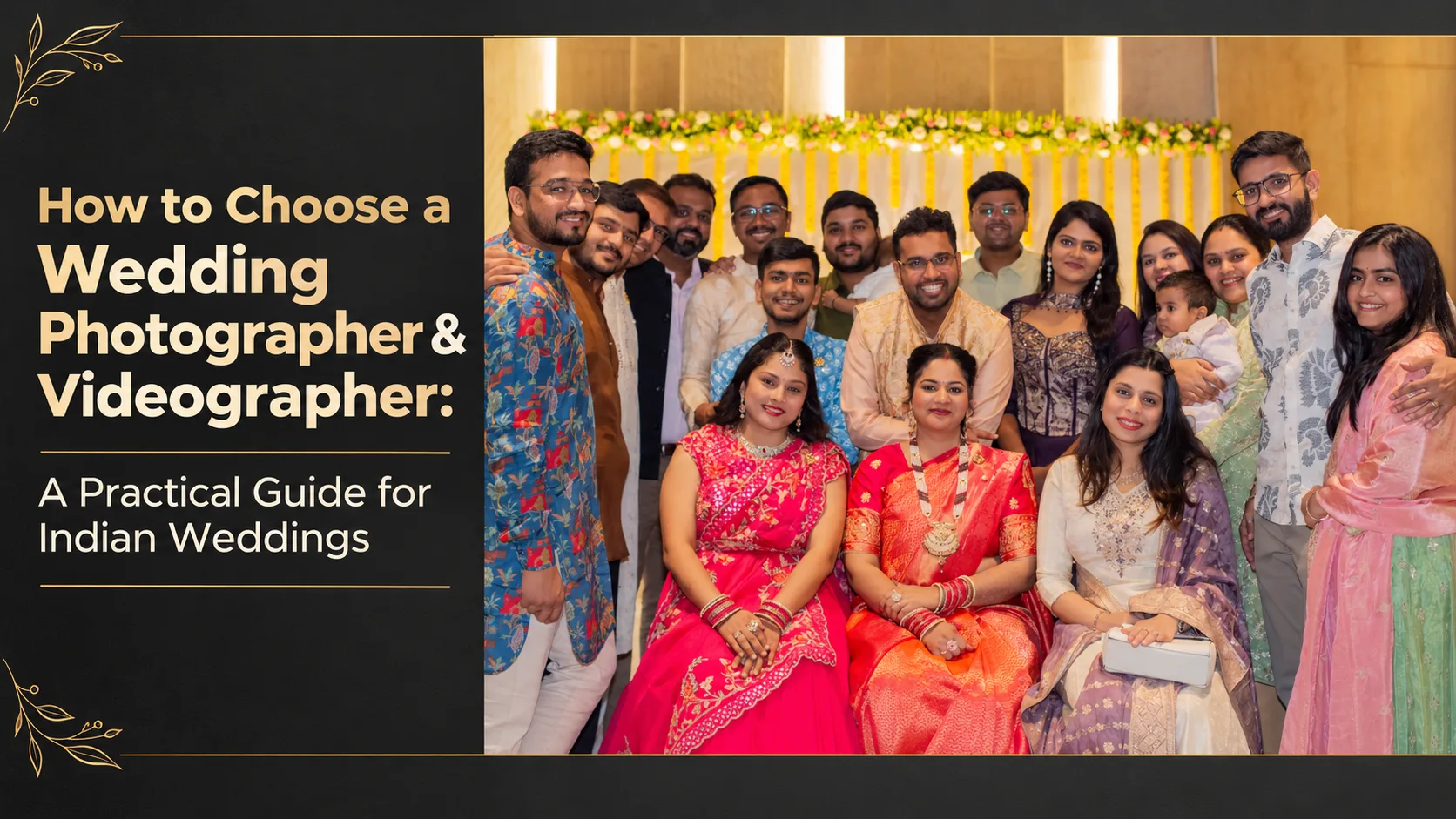
How to Choose a Wedding Photographer & Videographer: A Practical Guide for Indian Weddings
Once the last guest leaves and the décor comes down, your photographs and wedding film are what remain. They record your mother fixing your dupatta before the pheras, the baraat reaching the gate, and a grandparent’s quiet blessing at the vidaai. Knowing how to choose a wedding photographer and videographer is one of the most important decisions in your planning, and one of the easiest to get wrong if you judge only by a polished Instagram feed.
In our 9+ years as wedding planners in Mumbai, and on weddings across Jaipur, Lonavala, Karjat and Goa, we have worked alongside many photography and film teams. This guide covers what we look for when couples ask us to help them choose.
Understand Wedding Photography Styles Before You Shortlist
Before you look at portfolios, decide what kind of pictures you want. Most teams work across several styles, but each has a natural strength.
Traditional photography
Posed, well-lit group and family portraits. It is essential for Indian weddings, where every side of the family expects a formal photograph on stage. Traditional coverage makes sure no relative is missed.
Candid photography
Unposed moments: laughter at the haldi, tears during the kanyadaan, friends dancing at the sangeet. Candid work depends on the photographer anticipating moments rather than directing them.
Documentary photography
A storytelling approach that records the day as it happens, including the in-between moments. It suits couples who want an honest record over styled frames.
Editorial and fashion-style photography
Magazine-style couple portraits with deliberate posing, lighting and composition. It works well for pre-wedding shoots and couple portraits at heritage or five-star venues. Plan your wedding outfits as a couple with the camera in mind, because coordinated colours photograph far better than clashing ones.
Fine-art photography
Soft, artistic images with a distinct edit, often film-inspired. The look is beautiful, but check whether it suits the bright colours of your outfits and décor.
Cinematic and traditional videography
Cinematic videography produces a short, music-led highlight film edited like a movie. Traditional videography records ceremonies in full, which families often value for rituals. Many couples want both.
Our advice: most Indian weddings need a mix. A common structure is candid and cinematic coverage for the couple and key moments, with a dedicated traditional photographer and videographer for stage and family coverage.
Review Full Wedding Galleries, Not Just Instagram Highlights
Instagram shows a photographer’s best ten frames from a wedding. Your album will contain hundreds. We suggest the same approach we recommend for choosing wedding decorators in Mumbai: look past the highlights and study complete work. Ask for two or three full wedding galleries and check the following:
- Consistency: does the quality hold across the whole event, or only in the hero shots?
- Low light: look at sangeet, reception and night pheras photos. Indoor ballrooms and evening lawns test a team’s skill more than daylight portraits.
- Skin tones and colour: are skin tones natural across different lighting? Are red and gold outfits rendered accurately?
- Crowded moments: pheras, varmala and baraat scenes are busy. Check whether the key moment is still clear.
- Family coverage: are parents, grandparents and siblings photographed well, or only the couple?
- Ceremony range: if your wedding has specific rituals, ask to see a wedding with similar ceremonies.
- Video samples: for videographers, watch a full-length film as well as a highlight. Check audio quality during vows, speeches and pheras.
If possible, ask for a gallery from a venue similar to yours, such as a hotel ballroom, an open lawn or a hill resort.
Wedding Photography and Videography: One Team or Separate Specialists?
Photography freezes moments. Videography records movement, sound and the flow of events: your father’s speech, the dhol at the baraat, your vows in your own voice. Most couples book both.
A coordinated team from one studio usually means smoother on-ground work. Photographers and videographers who work together regularly know how to stay out of each other’s frames, share positions around the mandap and plan shots together.
Separate specialists make sense when you love one studio’s photography and a different studio’s films. This can work well, but it needs coordination. Both teams should share the event schedule, agree on positions during key rituals and be briefed together. When we plan a wedding, we hold a joint vendor briefing so that photo and video teams work from the same timeline as the décor, entertainment and hospitality teams.
Check Experience With Your Kind of Wedding
A photographer who shoots beautiful intimate ceremonies may not be ready for a three-day, 800-guest celebration. Match experience to your format:
- Intimate weddings: a small team with a strong candid eye often works best.
- Large celebrations: you need enough team members to cover the stage, the couple and guests at the same time. Guest moments at the food counters and live stations often become some of the best candid frames, so share the catering layout with your team.
- Multi-day Indian weddings: ask how they manage fatigue and consistency across the haldi, mehendi, sangeet, wedding and reception.
- Outdoor and open lawn ceremonies: they need confidence with harsh daylight and fast-changing evening light. Our open lawn wedding guide covers the venue side of this.
- Resort weddings: events spread across lawns, poolside areas and banquet halls need a team that plans movement between spaces.
- Destination weddings: the team must be comfortable with travel, a site recce and unfamiliar locations.
Ask directly: “How many weddings of this size and format have you shot, and can we see one?”
Understand Wedding Photography Packages and Pricing
Wedding photography packages in India vary widely, and two quotes can look similar while covering very different things. Compare inclusions, not just the total. A package may include:
- Number of days and events covered, and hours per event
- Team size: photographers, videographers and assistants per event
- Number of edited photographs, or whether all usable photos are delivered
- Printed albums: number, size and pages
- Highlight film, teaser and full-length ceremony films
- Pre-wedding shoot
- Drone coverage, where the venue permits it
- Detail shots of décor, invitations and welcome hampers and gifting
- Travel, accommodation and meals for the team
- Raw footage and the cost of extra editing rounds
- Charges for overtime or an added event
Inclusions differ by vendor, so ask for a written, itemised quote. What drives the cost up is usually the number of events, team size, travel, and the number of films and albums, rather than the photographer’s name alone. If you are building your overall budget, our guide on how much a wedding planner costs in Mumbai explains how professional wedding fees are usually structured.
Questions to Ask a Wedding Photographer Before Booking
Take this list to every meeting:
- Are you available on all our dates, and will you personally shoot our wedding?
- Who else will be on the team, and can we see their work?
- How many team members will cover each event?
- What backup cameras, memory cards and lighting do you carry?
- How do you back up files during and after the wedding?
- What exactly do we receive, in what format, and when?
- How many rounds of changes are included for albums and films?
- What is the payment schedule, and when is the balance due?
- What are the cancellation and date-change terms?
- Can you use our photos on your website or social media? Can we opt out?
- Do you charge for team travel, stay or overtime?
- Have you shot at our venue before? If not, will you do a recce?
Put every answer that matters into the contract.
Assess Communication and Working Style
Your photographer will be closer to you on your wedding day than almost anyone else. Comfort matters. In the first meeting, notice whether they listen to what you want or only sell their package.
Good wedding photographers also work well with others. They follow the event schedule, respect the priest’s space during rituals, coordinate with the décor and lighting teams, and adapt when timings change. As planners, our team notices the difference immediately. Photographers who communicate well with the planner help the day run on time and still capture every key moment.
Plan Photography Around Your Wedding Venue
Location shapes light, movement and logistics. Share your venue details before you finalise the team.
Mumbai hotels and city venues
Five-star venues such as the Taj, Oberoi and St. Regis properties have beautiful interiors, but ballrooms often mix warm stage lighting with cooler ambient light. Experienced teams bring their own lighting. If your events are at different venues, allow travel time for the crew in the schedule, since city traffic affects how quickly a team can move and set up. Sea-facing venues offer lovely sunset portraits, so plan couple shoots around sunset timing. Our Mumbai wedding planning team builds these timings into the event schedule from the start.
Lonavala and Karjat resort weddings
For a wedding in Lonavala or a wedding in Karjat, resorts such as Stone Water in Karjat offer greenery, open lawns and hill views that photograph beautifully. Light can change quickly in the hills, especially in the monsoon, when mist and rain affect outdoor plans. Your photography team should visit or study the venue, plan covered backup spots for portraits, and schedule couple shoots around the best light.
Goa beaches and Jaipur palaces
Beach ceremonies bring bright midday sun and strong wind, which affects both photos and video audio. Heritage palaces and forts bring grand backdrops but can have rules on equipment, lighting and drones. If you are planning a royal wedding in Jaipur, confirm these rules with the venue before finalising what your team will shoot.
Destination logistics
For destination weddings across India, agree on who books and pays for the team’s travel and rooms, when they arrive, whether they need a recce day, and how equipment will be transported.
Common Mistakes to Avoid When Hiring a Wedding Photographer
- Choosing on price alone. A cheaper quote with a smaller team or fewer deliverables can cost you moments you cannot recreate.
- Relying only on social media. Always see full galleries and full-length films.
- Skipping the contract. Verbal promises about team size, delivery and album specifications need to be in writing.
- Ignoring delivery timelines. Agree on dates for teasers, edited photos, films and albums.
- Being vague about deliverables. “Unlimited photos” and “cinematic film” mean different things to different studios. Ask for specifics.
- Not sharing a shot list. Tell the team which family members, rituals and details matter most to you.
- Booking too late. Popular teams fill peak wedding season dates early.
Wedding Photographer & Videographer Selection Checklist
Before you confirm a booking, make sure you have:
- Decided on your preferred mix of styles
- Reviewed at least two full wedding galleries and one full-length film
- Seen work from a similar venue type and wedding size
- Met or spoken to the lead photographer who will shoot your wedding
- Received an itemised, written quote
- Confirmed team size for each event
- Confirmed backup equipment and file backup process
- Agreed on delivery timelines for every deliverable
- Clarified travel, stay and overtime charges
- Read the payment, cancellation and image usage terms
- Shared your venue details and event schedule
- Introduced the team to your wedding planner
Conclusion
Learning how to choose a wedding photographer and videographer comes down to a few steps: understand the styles you love, judge full galleries rather than highlights, compare packages line by line, and put every promise in writing. Match the team to your venue and wedding format, and make sure they can work smoothly with the rest of your vendors.
At Reetireevaj, we have planned weddings for 425+ couples, and part of that work is bringing the right vendors together and keeping them on one timeline. Explore our end-to-end wedding planning services or browse our wedding portfolio to see how we plan. If you only need help with part of the process, our wedding planning FAQ explains how our tailored services work. When you are ready, get in touch with our team.
FAQ
How many photographers and videographers do we need for an Indian wedding?
It depends on your guest count and the number of events. Most weddings need at least one candid photographer, one traditional photographer and one videographer for the main ceremony. Large or multi-venue weddings need a bigger team so the stage, the couple and guests are covered at the same time.
Is a pre-wedding shoot worth it?
For most couples, yes. It helps you get comfortable in front of the camera and shows you how the photographer works before the wedding day. You can also use the photos for invitations, save-the-dates and a welcome display at the venue.
Can we use drones for wedding photography?
Only where the venue permits it and local rules allow it. Many hotels, heritage properties and areas near airports restrict drone use. Confirm permissions with your venue before paying for drone coverage.
How do photographers handle rain at outdoor weddings in Lonavala or Karjat?
Experienced teams carry weather protection for their equipment and plan covered spots for portraits in advance. They also schedule couple shoots around breaks in the weather. Your planner should confirm an indoor backup space at the resort so the photography schedule can shift without losing key moments.
Can we get the raw photos and unedited footage?
Some photographers include raw files and others charge extra or do not share them at all. Ask about this before booking and write the answer into your contract.
What happens if our photographer cannot attend on the wedding day?
A professional studio should have a backup plan, such as a replacement photographer of a similar standard. Ask who would step in, whether you can see their work, and make sure the contract covers this situation.
How does a wedding planner help you choose a photographer and videographer?
A planner shortlists teams that suit your style, venue and wedding size, and compares their quotes for you. They also brief the team alongside your décor, catering and entertainment vendors. At Reetireevaj, we coordinate photo and video teams through the full event timeline so every key moment is covered.